
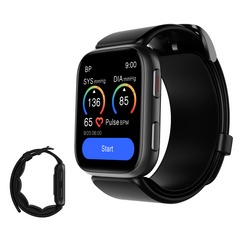
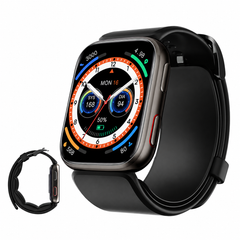
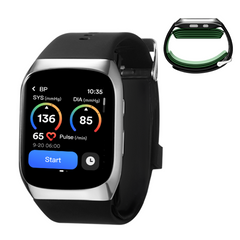
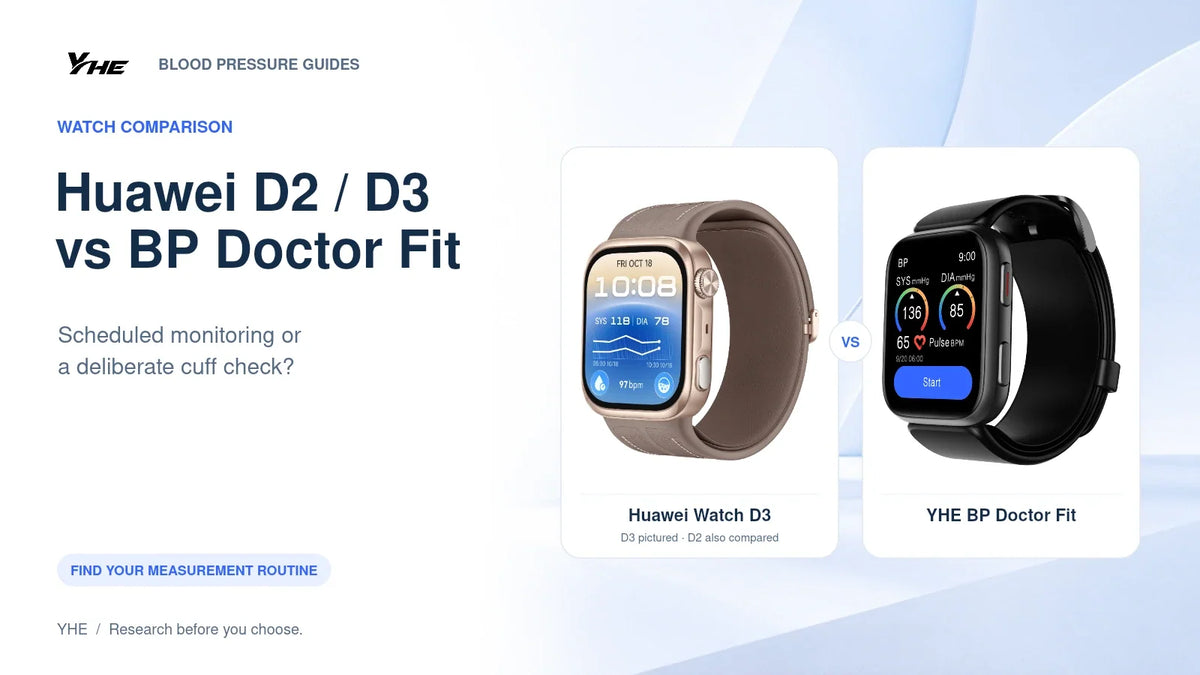
Choose between Huawei Watch D2, Watch D3 and YHE BP Doctor Fit by the monitoring job you need done. Huawei's UK pages describe 24-hour ambulatory blood pressure monitoring plans and reports for D2 and D3. Fit is a simpler on-demand cuff-watch option. The fact that all three use an inflatable cuff does not make their monitoring workflows interchangeable.
This YHE editorial guide uses manufacturer documentation checked on October 22, 2026. Huawei information here refers to its UK listings. It is not confirmation of U.S. authorization, local stock or warranty coverage.
The difference that matters before screen size
| Question | Huawei Watch D2 / D3 | YHE BP Doctor Fit |
|---|---|---|
| How is BP obtained? | Inflatable wrist airbag with oscillometric measurement | Inflatable wrist cuff with oscillometric measurement |
| Why shortlist it? | Investigate Huawei's 24-hour monitoring plan and ABPM report workflow | Evaluate a watch for deliberate on-demand checks |
| What needs regional checking? | Exact model, BP feature access, app and local regulatory labeling | Shipping, app access and evidence for intended use |
| What is not established here? | Suitability for your clinician's requested assessment | Equivalence to Huawei ABPM or U.S. BP medical clearance |
D3 is a current model, so check which comparison you are reading
Older discussions naturally focus on D2. Huawei now has a UK Watch D3 page as well. The listed screen changes from D2's 1.82-inch AMOLED to D3's 1.92-inch AMOLED, and D3 highlights a slimmer profile. Those are practical interface and wearability differences, not evidence that every reading is more accurate.
If you are deciding between a discounted D2 and D3, ask what the newer model changes in your intended routine. Can you read the result comfortably? Is the correct airbag supplied? Which features require an update? Is support available where you live? A newer model name answers none of those questions by itself.
Read the footnotes as carefully as the feature cards. Huawei identifies update and compatibility conditions for some features. A planned software capability should not become a promise in a purchase comparison until it is available for the exact device and region.
What does ABPM add to the decision?
Ambulatory monitoring is designed around readings across a period of ordinary life, including daytime and nighttime. Huawei promotes schedules and reports that address that question. An isolated reading after breakfast asks a different question from a day-and-night pattern.
However, the label ABPM is not enough to determine whether a particular report will meet your clinician's needs. Successful measurements, timing, activities, sleep disruption and the device's authorized use all matter. If the purchase is meant to satisfy a medical request, obtain the requested protocol first.
Fit should not be described as a less expensive replacement for that full workflow. A fair reason to choose an on-demand watch is that you want intentional checks and do not need the competitor's scheduled assessment features. That is a narrower, clearer use case.
Battery comparisons need the same monitoring mode
Huawei's D3 page distinguishes normal battery claims from use with ABPM enabled; it lists up to one day with that feature on under its stated test conditions. This is a useful example of why comparing a general battery headline with an intensive measurement mode is misleading.
Plan charging around the use case you will actually enable. If overnight monitoring is the reason for buying, ask when charging can happen without interrupting that recording period. If you only need occasional checks, an ABPM-mode battery figure may tell you little about your normal routine.
Likewise, YHE's “up to” battery figures are manufacturer scenarios rather than a promise for every measurement frequency, screen setting or battery age. Match the assumptions before drawing a conclusion.
Buying across borders introduces another comparison
A UK product page can establish what Huawei advertises in that market. It does not establish that an imported unit will offer the same BP functions with your account, phone and country settings, or receive local after-sales service.
Before ordering, obtain answers to four questions from the authorized seller: Is this model officially sold in my market? Are the BP functions enabled there? Which app installation and phone requirements apply? Who handles an airbag or warranty issue?
Compare the complete local purchase rather than converting a foreign sale price into dollars. Shipping, return costs and support can change the practical value. We do not use an unverified imported price as the basis for naming a winner.
Use three purchase scenarios
- You need clinician-requested 24-hour assessment: discuss the approved device and report first. Investigate Huawei's regional documentation, but do not assume acceptance.
- You want a watch for planned quiet checks: compare the exact cuff fit, display and app workflow of Fit and the Huawei options.
- You mainly need a home record for treatment discussions: start with an appropriate validated upper-arm device rather than assuming a smartwatch is required.
What should a fair accuracy comparison include?
It should identify the exact model, validation protocol, population and measurement conditions. Two watches using air pressure are not proven equivalent, and a screen upgrade does not prove a better algorithm. We have not performed a matched clinical comparison of D2, D3 and Fit, so this guide does not award accuracy scores.
YHE's model comparison helps separate its own watch options. For a specific Fit package, see BP Doctor Fit. These links are purchase research, not evidence of equivalence to Huawei's ABPM features.
Frequently asked questions
Can I treat D2 and D3 as the same product?
No. Compare the exact generation, supplied airbag, available software and local labeling. A review of D2 should not automatically be used to support a D3 performance claim.
Is a CE-marked product automatically FDA-cleared?
No. Those are different regulatory systems. This article does not infer U.S. BP clearance from a Huawei UK product page or its CE-MDR statement.
Sources
Huawei Watch D2 UK specifications; Huawei Watch D3 UK specifications and footnotes; Huawei ABPM support; YHE product pages linked above. This is a brand-published document comparison, not a hands-on review.

Leave a comment
This site is protected by hCaptcha and the hCaptcha Privacy Policy and Terms of Service apply.