
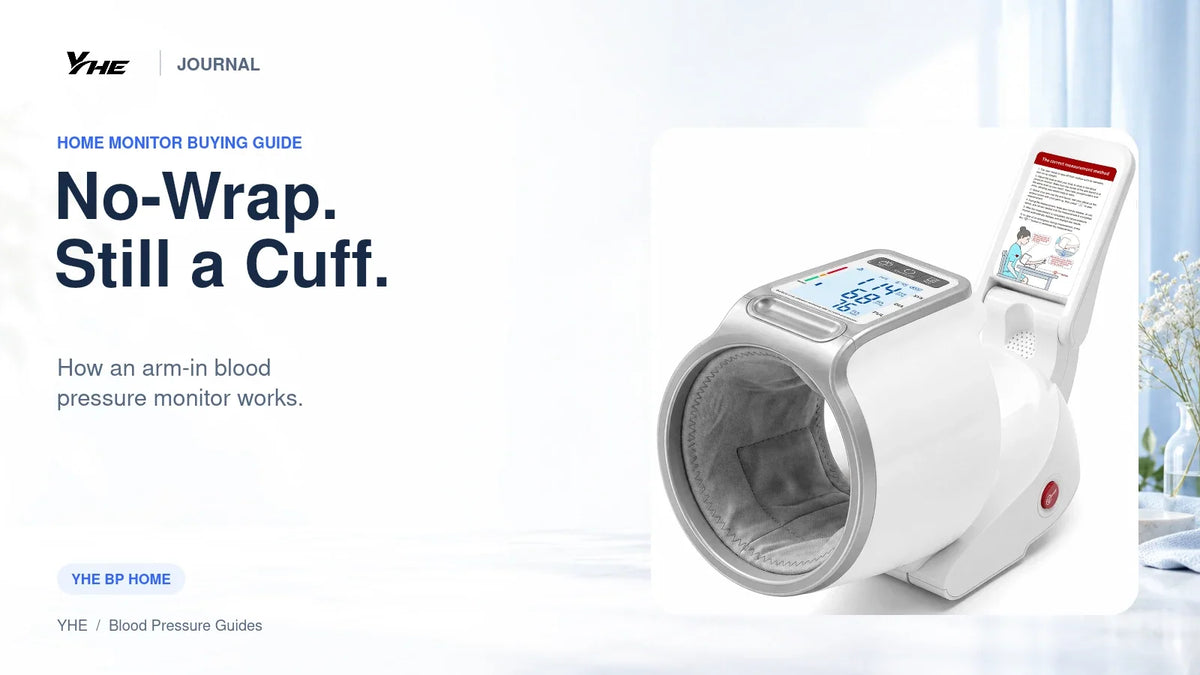
A no-wrap blood pressure monitor still uses an inflatable cuff. The difference is how you put it on: an integrated arm-in design lets you place your arm inside the device rather than manually fastening a separate wraparound cuff.
That can be an appealing design if cuff wrapping is the part of your home routine you dislike. Before buying, however, check the arm range, physical access, table space and evidence for the exact model. Removing a wrapping step does not remove the need for correct positioning.
In this guide
- No-wrap, cuffless and wireless do not mean the same thing
- What changes with an integrated upper-arm cuff?
- Where YHE BP Home fits
- Check physical access before assuming it is easier
- Make room for the device
- Correct preparation still matters
- Compare ownership details before the holiday sale
- Frequently asked questions
No-wrap, cuffless and wireless do not mean the same thing
| Term | What it describes | What to check |
|---|---|---|
| No-wrap or arm-in | The cuff is integrated into a structure you insert your arm into | Arm fit and whether you can position yourself comfortably |
| Cuffless | No inflatable cuff is used for the measurement itself | Exact method, intended use and regulatory evidence |
| Wireless | A connection or power arrangement | Whether it refers to Bluetooth, batteries or something else |
| Automatic | The device performs its measurement cycle after being started | Which preparation steps remain the user's responsibility |
These terms can overlap, but they are not substitutes. For example, a rechargeable monitor with an integrated cuff can operate without a mains cord during a reading while still using cuff pressure.
What changes with an integrated upper-arm cuff?
With a conventional separate cuff, you wrap and fasten the cuff around your upper arm according to its instructions. With an arm-in design, the monitor provides a fixed opening and integrated cuff arrangement.
The FDA record for K251102, which includes CH-S693L, describes an automated upper-arm oscillometric monitor with an integral cuff and arm-positioning structure.
For someone whose main frustration is managing a loose cuff and its fastening, that is a tangible design difference. It is not evidence that every integrated monitor is more accurate than every separate-cuff product.
Where YHE BP Home fits
YHE BP Home is the CH-S693L upper-arm model. Its product specifications list an 18–42 cm adult arm range, a 3.5-inch LCD, USB-C charging and memory for two users.
The most relevant buying question is whether this format makes your routine easier. Think about the task you are trying to simplify: fastening a cuff, handling separate components, reading the result, or keeping the device ready beside a chair.
If your existing validated monitor already works comfortably, there may be no reason to replace it. An upgrade is more meaningful when you can point to a practical problem the new design addresses.
Check physical access before assuming it is easier
An arm-in device still requires you to reach the opening, position your arm and withdraw it comfortably. Its usability will depend on the person, chair, table height and available movement.
If shoulder movement, hand function or another limitation affects your routine, ask to review the setup demonstration and discuss the situation with a healthcare professional. Do not assume a no-wrap design makes independent operation possible for everyone.
Before buying for a parent, ask them to describe what is difficult about their current cuff. If the problem is remembering the routine rather than fastening the cuff, an integrated design may not address the main issue.
Make room for the device
An integrated monitor is a home appliance, not necessarily a compact travel accessory. Check the published dimensions and weight, and compare them with the surface where you plan to use it.
Choose a stable place with a comfortable chair. Avoid a cramped corner that forces you to lean or twist. Store the charging equipment nearby without creating a trailing-cable hazard.
It helps to decide whether the monitor will remain ready for use or be put away between sessions. A design that looks convenient on a large demonstration table may feel different on a small bedside cabinet.
Correct preparation still matters
The CDC's measurement guidance emphasizes resting beforehand, supporting the back and arm, keeping feet flat and avoiding talking. Follow your exact device instructions and your clinician's schedule.
Do not interpret “automatic” as permission to measure while adjusting the device, talking to a family member or leaning over a phone. A simplified cuff arrangement handles one part of the process; the user still prepares and sits correctly.
Bring a new monitor to an appointment if you need help checking technique or suitability. Regulatory clearance and independent validation are distinct evidence questions, and neither should be replaced by a customer testimonial.
Compare ownership details before the holiday sale
Look at the final checkout amount, included power accessories, warranty support and return conditions. Ask how to clean and store the device using the supplied instructions.
If two people will use it, confirm that both fit and that each person can select their own records. If you travel frequently, decide whether a stationary home device meets the main need before treating portability as a bonus.
During Black Friday or Christmas shopping, the practical question is not just whether a no-wrap monitor is discounted. It is whether removing that wrapping step is worth the price and space for your household.
Frequently asked questions
Is a no-wrap monitor a cuffless monitor?
No. A no-wrap design can have a built-in inflatable cuff. “Cuffless” describes a different measurement approach.
Does BP Home fit every adult?
No single size range fits everyone. Its listed upper-arm circumference range is 18–42 cm. Measure before buying.
Is an integrated cuff automatically more accurate?
No. Evaluate the specific model's evidence and use it correctly. A design that is easier for you is not the same as proven superiority in a clinical comparison.
Can I buy one for a parent who has trouble wrapping a cuff?
It is worth investigating, but confirm they can comfortably insert their arm and reach the controls. Ask which part of their existing setup is difficult.
Review BP Home's design and specifications to see whether it suits your home setup.
Sources
- FDA K251102 device description and indications
- CDC measurement guidance
- ValidateBP independent device-validation information
Product information checked October 22, 2026. This guide does not replace advice about your individual medical monitoring needs.

Leave a comment
This site is protected by hCaptcha and the hCaptcha Privacy Policy and Terms of Service apply.