

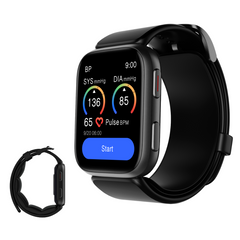
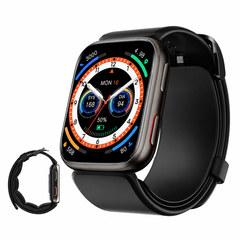
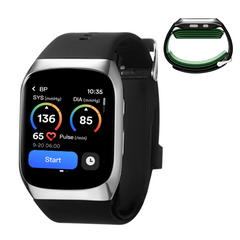
When an inflatable blood pressure watch tightens around your wrist, the watch is doing more than simply “reading a sensor.”
It is creating a controlled pressure cycle.
Inside that cycle are small pulse-related pressure changes.
Those changes are the raw information an oscillometric blood pressure system analyzes.
What Does “Oscillometric” Mean?
Every heartbeat creates changes in arterial pressure.
When a cuff applies external pressure around an artery, those pulsations produce small pressure oscillations inside the cuff.
An oscillometric device measures those changing pressure signals and uses an algorithm to estimate systolic and diastolic pressure.
That general principle is widely used in automatic blood-pressure monitors.
BP Doctor Fit's manual describes the watch as using an oscillometric method with a wrist air cuff that is pressurized during measurement.
BP Doctor Med's manual similarly identifies its measurement principle as oscillometric and the measuring location as the wrist.
A Simplified Measurement Cycle
The process can be understood in five stages.
Stage 1 — Correct fit
The cuff first has to make appropriate contact with the wrist.
If it is too loose, too tight, folded or misaligned, the pressure signal can change.
Fit's manual explicitly warns that wearing tightness affects the measurement and describes correct cuff contact as important.
Stage 2 — Inflation
The watch's internal pump increases cuff pressure.
Stage 3 — Pulse signal detection
As pressure changes, the device detects oscillations associated with arterial pulsation.
Stage 4 — Signal processing
The device's algorithm analyzes the pressure pattern.
Stage 5 — Result
The watch displays:
SYS
Systolic blood pressure
DIA
Diastolic blood pressure
Pulse
Why Wrist Height Matters
Oscillometric measurement does not make the laws of hydrostatic pressure disappear.
If the wrist is significantly below heart level, the pressure relationship changes.
Fit's instructions state that measurements taken with the wrist below heart height may read higher, while positioning above heart height may read lower.
This is why a correct measurement should look more like:
sit → support arm → bring wrist to heart level → relax → start
and less like:
stand → glance at watch → press button while walking.
Why Watch Tightness Matters
A smartwatch normally needs to be comfortable enough for all-day wear.
A blood-pressure cuff needs sufficiently stable contact during measurement.
Those two jobs create a design challenge.
Fit therefore includes a wrist measurement guide and recommends a more secure fit for BP measurement than casual daily wear. The manual also notes that a too-loose cuff may produce unstable signals.
Why Movement Matters
Pressure sensors are trying to detect relatively small oscillations.
Movement introduces other pressure changes.
That is why the instructions repeatedly tell users not to:
- talk;
- shake the hand;
- clench the fist;
- bend the wrist;
- move during measurement.
This is not unique to YHE.
It is a general reason blood-pressure measurement should be taken under controlled conditions.
How Is This Different From an Optical Sensor?
An optical sensor measures changes in reflected light from tissue.
An oscillometric cuff measures pressure oscillations.
Both may exist in the same smartwatch, but they are not the same sensor and should not be described as though one directly substitutes for the other.
BP Doctor watches also contain optical health sensors for other health features, but the cuff-based BP workflow relies on pressure-based measurement.
Single Cuff vs Dual Cuff
Fit and Ultra use a single integrated inflatable wrist cuff.
Med uses a dual inflatable cuff structure.
The measurement site remains the wrist, and correct positioning remains necessary in both designs.
The number of cuffs should therefore be presented as a hardware design difference—not as permission to ignore fit or posture.
What Oscillometric Does Not Mean
It does not mean:
- every wrist reading must match an upper-arm reading;
- posture no longer matters;
- every device using the same principle performs identically;
- one reading should be used to diagnose a condition;
- blood pressure is continuously monitored.
Fit's own manual notes that wrist and upper-arm readings can differ because the measurement sites and vessel characteristics differ.
FAQ
Is BP Doctor Fit oscillometric?
Yes. Its documentation describes a pressurized wrist air cuff and oscillometric measurement.
Does BP Doctor Med use oscillometric measurement?
Yes. Med's manual lists the oscillometric method and wrist measurement.
Does oscillometric mean continuous BP?
No. The cuff must run through a measurement cycle. Fit's BP readings are started on demand.
Why shouldn't I talk during a measurement?
Movement and muscle activity can introduce interference while the system is measuring cuff-pressure oscillations.
Final Takeaway
A cuff-based blood pressure watch works because it creates and measures a controlled pressure event around the wrist.
The key words are:
inflation
pressure oscillation
position
signal processing
Understanding that explains why the watch needs to fit correctly and why a proper measurement looks different from simply checking your heart rate.
Leave a comment
This site is protected by hCaptcha and the hCaptcha Privacy Policy and Terms of Service apply.