

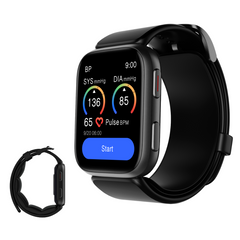
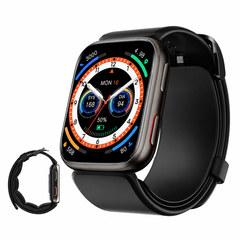
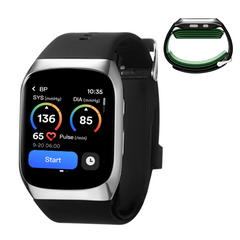
Inflatable Cuff vs Optical Blood Pressure Smartwatch
Two smartwatches can display blood-pressure information while using completely different physical principles.
That makes “Does this watch measure blood pressure?” a surprisingly incomplete question.
A better question is:
How does it produce the number?
One important distinction is between:
physical cuff-based measurement
and
sensor-based estimation.
What Happens With an Inflatable-Cuff Watch?
An inflatable-cuff watch contains an air bladder integrated into the wristband.
During a measurement:
- the cuff applies pressure to the wrist;
- pressure changes affect blood flow through the artery;
- the device detects pulse-related pressure oscillations;
- an algorithm processes the signal;
- SYS, DIA and pulse are displayed.
BP Doctor Fit's manual describes its wrist air cuff being pressurized during measurement while the system detects pressure signals associated with the wrist artery.
The important point is:
The cuff itself participates physically in the measurement.
That makes this technology closer in concept to familiar automatic cuff-based blood-pressure measurement than to a watch that relies only on light-based sensor data.
What Happens With an Optical Estimate?
Optical smartwatches typically shine light into the skin and detect changes associated with blood flow.
Those signals can be extremely useful for:
- heart rate,
- rhythm information,
- blood oxygen on supported devices,
- activity metrics.
Blood-pressure estimation is a different task.
Samsung's current smartwatch BP system requires the user to calibrate the watch with a conventional upper-arm cuff and repeat that calibration every 28 days.
So the user workflow becomes:
upper-arm reference cuff → calibration → watch estimate → periodic recalibration.
That is fundamentally different from a watch in which an inflatable cuff is built into the band.
What About Apple Watch?
Apple's hypertension notification system should not be placed in either column as though it were the same type of product.
It analyzes optical heart-sensor data over longer periods for patterns associated with possible hypertension rather than providing an ordinary on-demand 120/80-style reading.
So there are really three consumer experiences:
| Approach | Physical Cuff | External Calibration | Traditional SYS/DIA Reading |
|---|---|---|---|
| Inflatable-cuff watch | Yes | Usually no | Yes |
| Calibrated optical estimate | No | Yes | Yes |
| Hypertension pattern notification | No | No | No conventional on-demand BP reading |
Why This Difference Matters in Shopping
If blood pressure is the primary reason you are buying the watch, the technology should appear near the top of your checklist.
Don't let these features distract you first:
- workout modes;
- watch faces;
- weather;
- message notifications;
- music controls.
Those features may be useful, but they do not explain the BP measurement process.
Cuff-Based Does Not Mean Position Doesn't Matter
A physical cuff does not eliminate technique.
For wrist measurement, the measurement site should remain around heart level.
Fit's instructions explicitly state that a wrist below heart level may read higher, while a wrist above heart level may read lower. The manual also notes that strap tightness, talking and movement can affect the result.
So the real formula is:
measurement technology + correct technique
not technology alone.
What Is YHE's Approach?
Current Fit and Ultra models use single inflatable wrist cuffs and pressure-based measurement. Med uses dual inflatable cuffs.
This means YHE's product differentiation is not simply:
“another smartwatch with health sensors.”
It is:
a smartwatch built around a physical inflatable BP cuff.
That is the story the product page, ads and editorial content should consistently tell.
Which Approach Should You Choose?
Choose based on workflow.
Inflatable cuff may fit you if:
- you specifically want a physical cuff;
- you do not want to carry a separate cuff for routine watch measurements;
- BP is a major reason for buying the watch.
Calibrated optical may fit you if:
- you already own the relevant smartwatch ecosystem;
- you don't mind maintaining a separate reference cuff;
- periodic recalibration is acceptable.
Hypertension notifications may fit you if:
- you want passive awareness;
- you understand that this is not an on-demand BP reading.
FAQ
Does an inflatable BP watch use optical sensors?
A smartwatch may contain optical sensors for other health functions, but the BP measurement can use a separate inflatable pressure-cuff process.
Do YHE watches require an external cuff to start routine BP readings?
Current BP Doctor Fit, Ultra and Med use their built-in wrist cuffs for their on-demand BP measurements.
Is optical estimation inaccurate?
That conclusion is too broad. Different technologies have different validation, calibration and regulatory requirements. The important step is to understand which technology the specific product uses.
Why does Samsung require calibration?
Samsung states that its smartwatch BP feature requires calibration using an upper-arm cuff and repeat calibration every 28 days.
Final Takeaway
A BP watch should never be judged by the phrase “blood pressure” alone.
Ask:
Is there a cuff?
Does it physically inflate?
Does it need calibration?
Does it actually output SYS/DIA?
Those four questions explain most of the difference between today's blood-pressure smartwatch approaches.
YHE internal links
BP Doctor Fit · BP Doctor Ultra · BP Doctor Med · Compare Models
Leave a comment
This site is protected by hCaptcha and the hCaptcha Privacy Policy and Terms of Service apply.