

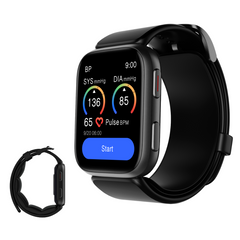
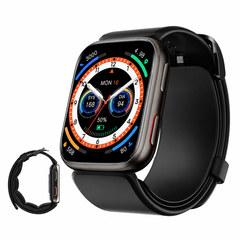
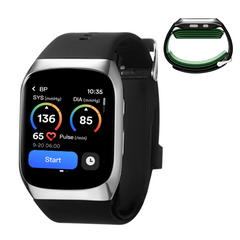
Take a blood pressure reading with an upper-arm cuff.
Then take another at your wrist.
You may not get exactly the same number.
That does not automatically mean one device is broken.
You measured at two different places on the circulatory system.
The Measurement Site Is Different
An upper-arm monitor measures around the brachial artery.
A wrist device measures closer to the radial artery.
The artery size, surrounding tissue, distance from the heart and position of the measurement site differ.
Fit's manual explicitly notes that wrist and upper-arm readings can differ because of differences in the measurement location and blood-vessel characteristics.
That is why comparing one random wrist reading with one random arm reading is a weak test.
Wrist Position Creates an Extra Variable
An upper-arm cuff can be supported fairly naturally around heart level when someone sits at a table.
The wrist is easier to move.
Raise it.
Lower it.
Rotate it.
Bend it.
That makes correct heart-level positioning particularly important.
Fit's manual states that a wrist positioned below the heart may read higher and one positioned above the heart may read lower.
What Do Current Guidelines Say?
For formal home blood pressure monitoring, the American Heart Association recommends an automatic, validated, cuff-style upper-arm monitor and notes that wrist and finger devices are generally less reliable.
That is important context.
A blood-pressure watch should not be sold as though medical guidelines have suddenly stopped favoring upper-arm monitoring.
Instead, a wearable should be understood for what it adds:
portability and easier access to an on-demand measurement.
Why Would Someone Still Want a Wrist BP Watch?
Because convenience changes behavior.
A large upper-arm monitor often stays:
- at home;
- in a drawer;
- next to a chair;
- in a travel bag only when deliberately packed.
A watch stays on the wrist.
For someone who values the ability to take a properly positioned wrist reading without setting up a separate device every time, that convenience can be meaningful.
But convenience is not the same as saying:
“The wrist is medically preferred over the upper arm.”
Those are two different claims.
How to Compare Two Devices More Sensibly
If you want to understand how your wrist and upper-arm devices behave, avoid this:
arm reading at 8:00 AM
wrist reading after coffee at 11:30 AM
Instead:
- rest;
- use the same sitting posture;
- avoid talking;
- measure under similar conditions;
- keep each device in its correct position;
- allow the recommended time between readings;
- compare a series of readings, not one isolated pair.
Even then, don't expect perfect numerical identity.
What About YHE's New BP Home?
YHE now also has an automatic upper-arm product line, which makes this topic strategically important.
The role split becomes much clearer:
BP Home / Upper Arm
A dedicated home measurement station.
BP Doctor Watch
A wrist-based wearable for on-demand measurements and everyday smartwatch use.
That gives the customer two different solutions rather than forcing one product to claim it replaces everything.
Where Fit, Ultra and Med Differ
All three current BP Doctor watches measure at the wrist.
Fit and Ultra use single inflatable cuffs; Med uses a dual-cuff design. Fit and Ultra currently recommend approximately 14–22 cm wrist fit, while Med lists approximately 14–20 cm.
The critical point remains the same:
The watch must fit and the wrist must be positioned properly.
FAQ
Should wrist and arm BP readings be identical?
Not necessarily. They are taken at different measurement sites.
Which type does AHA recommend for home monitoring?
AHA recommends an automatic, validated upper-arm cuff-style monitor.
Why buy a blood pressure watch then?
Wearable convenience and portability are the main differences.
Can I compare a BP Doctor with my arm monitor?
You can observe patterns, but use both devices correctly and do not expect every pair of readings to match exactly.
Final Takeaway
The best way to frame wrist vs upper arm is not:
winner vs loser.
It is:
home standard vs wearable convenience.
A buyer may reasonably want one, the other—or both.
Continue comparing
BP Doctor Fit · BP Doctor Ultra · BP Doctor Med · Compare BP Doctor Models
Leave a comment
This site is protected by hCaptcha and the hCaptcha Privacy Policy and Terms of Service apply.