

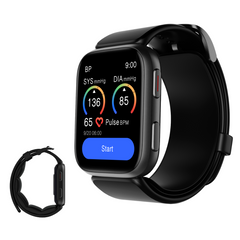
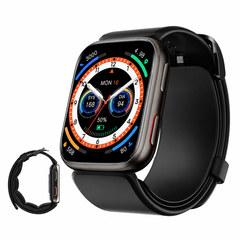
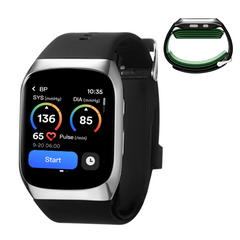
“Wearable blood pressure monitor” sounds like one product category.
It isn't.
In 2026, the phrase can describe several very different technologies:
- a smartwatch with an inflatable cuff;
- a wrist device that estimates BP after calibration;
- a watch that detects patterns associated with hypertension;
- an ambulatory BP device that automatically measures at scheduled intervals.
Those products do not all answer the same question.
So before choosing one, it helps to understand what “wearable” actually means.
Four Types of Wearable BP Technology
1. Inflatable-cuff smartwatch
This is the approach used by BP Doctor Fit, Ultra and Med.
A physical cuff inside the wristband inflates during a measurement and detects pressure oscillations.
Fit's manual describes the system as a wrist air cuff using an oscillometric measurement method.
The key benefit is straightforward:
the pressure cuff travels with the watch.
2. Calibrated sensor-based BP watch
Some watches use sensor data to estimate blood pressure after being calibrated against a conventional upper-arm monitor.
This can reduce the need for an inflatable cuff inside the watch—but it changes the workflow.
Samsung, for example, requires a compatible Galaxy Watch BP feature to be calibrated using an upper-arm monitor and recalibrated every 28 days.
3. Hypertension notification watch
This category is easy to confuse with measurement.
Apple's hypertension notifications analyze optical sensor information over time for patterns associated with possible high blood pressure. They are not the same as taking an ordinary on-demand 120/80-style BP reading.
4. Wrist ambulatory BP monitor
Huawei Watch D2 pushes the wearable concept closer to ABPM.
It uses an inflatable cuff and offers scheduled measurements over a 24-hour plan, calculating daytime, nighttime and full-day averages. Huawei markets the product globally as CE-MDR certified.
This is a different use case from simply pressing a button for an occasional reading.
Quick Comparison
| Technology | Cuff Inflates? | On-Demand SYS/DIA? | External Calibration? | Scheduled 24h BP? |
|---|---|---|---|---|
| BP Doctor Fit/Ultra/Med | Yes | Yes | No separate cuff for routine reading | No |
| Samsung BP feature | No | Yes | Yes | No |
| Apple Hypertension Notifications | No | No traditional on-demand reading | No | Passive pattern analysis |
| Huawei Watch D2 | Yes | Yes | No | Yes |
This is why buying purely from the phrase “wearable blood pressure monitor” is risky.
You need to identify which column the product belongs to.
What Makes a Wearable BP Monitor Useful?
The biggest advantage is not necessarily that it measures more often.
It is:
availability.
A home monitor can be excellent but still sit at home.
A wearable stays with the user.
That may make it easier to build a consistent measurement routine when the device is used properly.
But Wearable Does Not Mean “Measure While Moving”
This is one of the most important expectations to set.
Blood pressure measurement is not like step counting.
For cuff-based wrist measurements, the user should stop, sit, position the wrist correctly and remain still.
Fit's instructions call for a seated position, a relaxed posture and the wrist around heart height.
So “portable” should mean:
easy to have with you
not:
accurate BP readings while walking through an airport.
How YHE's Wearable BP Lineup Fits the Category
Fit
Best suited to buyers who want the core cuff-based measurement experience at the lowest YHE price.
Ultra
The premium single-cuff choice, with redesigned UI and one year of Premium App included.
Med
The dual-cuff BP-first choice.
The current comparison page confirms all three use wrist-based pressure measurement, while the primary hardware difference is single versus dual cuff.
What About FDA Authorization?
This is where buyers should be especially careful.
The FDA warned in 2025 against unauthorized devices—including wearable software—that claim to measure or estimate blood pressure, and recommends checking the exact device in the FDA database.
That means:
“FDA registered”
is not enough.
Neither is:
“medical-grade”
without supporting evidence.
The exact device and its actual regulatory status matter.
I'll return to YHE's current evidence position in the Evidence Center page below.
Wearable vs Home Upper-Arm Monitor
This does not need to be a war.
A wearable and an upper-arm monitor can fill different roles.
Wearable
- portable;
- always nearby;
- wrist measurement;
- smartwatch functions.
Upper arm
- dedicated home device;
- guideline-preferred measurement location;
- easier to standardize for formal home monitoring.
AHA currently favors validated automatic upper-arm devices for home BP monitoring.
So YHE's expansion into BP Home actually strengthens the brand story:
On the wrist → BP Doctor
At home → BP Home
FAQ
Does wearable BP mean continuous BP?
No.
Are all wearable BP monitors cuffless?
No. BP Doctor, Omron HeartGuide, Wellue BPW1 and Huawei D2 all use inflatable cuff technology in some form.
Is wrist BP the same as upper-arm BP?
No. Measurement site and positioning differ.
What should I check first when buying?
Measurement method, regulatory evidence, fit, correct-use instructions and whether the device fits your actual use case.
Final Takeaway
“Wearable blood pressure monitor” is too broad to be useful by itself.
Always ask:
Does it inflate?
Does it estimate?
Does it alert?
Does it require calibration?
Is it designed for on-demand or ambulatory measurement?
Once you know that, comparing products becomes much easier.
Leave a comment
This site is protected by hCaptcha and the hCaptcha Privacy Policy and Terms of Service apply.