

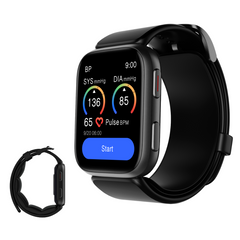
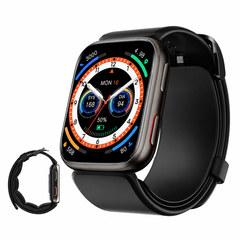
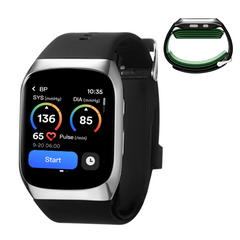
Travel is one of the clearest reasons someone might choose a blood pressure smartwatch instead of relying only on a larger home monitor.
You don't need to pack:
- a separate monitor;
- a large cuff;
- tubing;
- batteries;
- another case.
The measurement device is already on your wrist.
That convenience is real.
But there is one thing it does not change:
You still need to stop and measure correctly.
What Makes a BP Watch Good for Travel?
For travel, I would care about five things.
1. The BP hardware is actually built in
If a watch requires a separate upper-arm monitor for regular calibration, then you may still need another device in the suitcase.
A cuff-based watch such as BP Doctor Fit, Ultra or Med keeps the inflatable cuff in the wristband itself.
2. Battery life is long enough for the trip
Current YHE listings state:
- Fit: up to 10 days;
- Ultra: up to 10 days;
- Med: up to 7 days.
Actual battery depends on screen use, Bluetooth and measurement frequency.
For a weekend or short trip, that can reduce charging friction.
For a longer trip, pack the charger anyway.
3. Your readings stay organized
Travel days are messy.
Airports, meals, sleep disruption and different time zones can make a handwritten log easy to forget.
Fit keeps recent records on the watch and syncs additional history to the BP Doctor App.
That can be more practical than trying to remember:
“Was that reading from Monday morning or Tuesday night?”
4. The watch fits securely
Travel is not the time to discover your BP cuff is not the right size.
Fit and Ultra currently support approximately 14–22 cm BP wrist fit, while Med is approximately 14–20 cm.
Measure before you travel.
5. The correct measurement position is realistic wherever you are
This is the biggest issue.
A BP smartwatch is portable.
A good BP measurement is not “mobile.”
Do not measure while:
- walking to your gate;
- standing in a security line;
- dragging a suitcase;
- sitting unsupported on a luggage cart;
- talking on the phone.
Instead:
find a seat → rest → support your arm → keep the wrist at heart level → stay still → measure.
Fit's instructions make heart-level position and stillness explicit.
Air Travel, Time Zones and BP Records
Travel can change routine.
Your sleep may be different.
Meals may be different.
Stress may be higher.
The point of a wearable should not be to take dozens of random readings.
A better use is to keep your routine more consistent than it would otherwise be.
If your clinician has given you a measurement schedule, follow that schedule.
If not, don't turn travel into constant self-checking.
Fit vs Ultra vs Med for Travel
| Fit | Ultra | Med | |
|---|---|---|---|
| Listed Battery | Up to 10 days | Up to 10 days | Up to 7 days |
| Display | 1.9" | 1.9" | 1.61" |
| Cuff | Single | Single | Dual |
| Wrist Fit | 14–22cm | 14–22cm | 14–20cm |
| App | Yes | Yes + 1y Premium | Yes |
| Travel Position | Best overall value | Premium | BP-first |
For most travelers, I would not choose based on the number of cuffs alone.
I would choose based on:
fit + battery + readability + price.
What a Travel BP Watch Should Not Promise
A serious travel page should never imply:
“Measure accurately anytime while doing anything.”
That is bad education.
Wrist blood-pressure measurement is still sensitive to posture and motion.
The value is:
having the device with you
not:
ignoring measurement technique.
Final Takeaway
A blood pressure smartwatch is useful for travel because it reduces what you have to carry.
It does not reduce what you have to do correctly.
For the best chance of consistent readings:
sit
rest
support the wrist
keep it at heart level
stay still
and then measure.
Leave a comment
This site is protected by hCaptcha and the hCaptcha Privacy Policy and Terms of Service apply.