

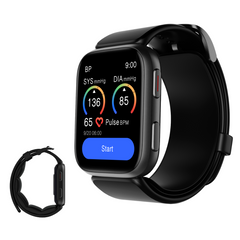
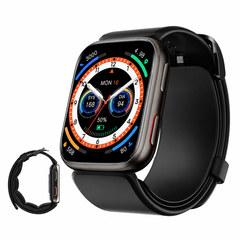
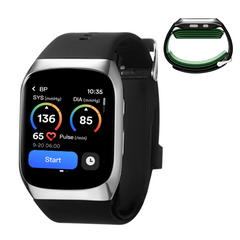
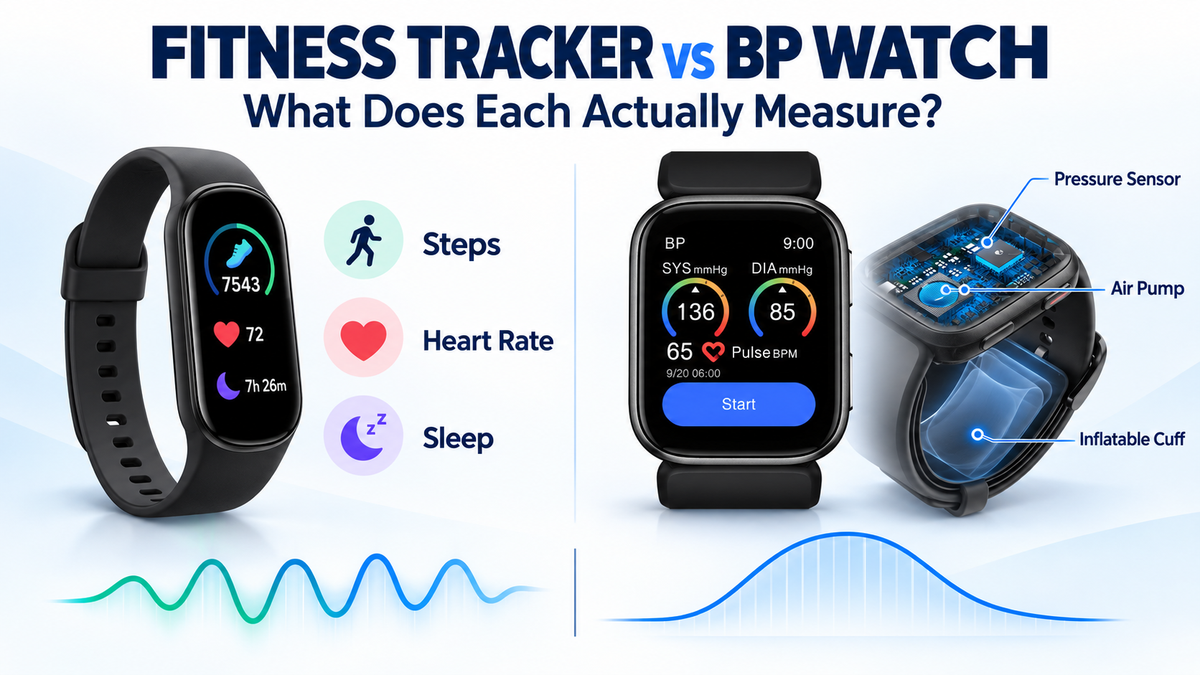
Most smartwatches with “blood pressure” in their feature list do not use a physical cuff.
These four are different.
BP Doctor Fit, Omron HeartGuide, Wellue BPW1 and Huawei Watch D2 all bring an inflatable pressure cuff to the wrist in some form.
That makes them much more useful to compare than putting Fit beside a generic optical smartwatch.
But they still differ substantially in:
- regulatory position;
- cuff size;
- battery;
- price;
- smartwatch features;
- ambulatory functions;
- app ecosystem.
Here's the comparison that actually matters.
At a Glance
| BP Doctor Fit | Omron HeartGuide | Wellue BPW1 | Huawei Watch D2 | |
|---|---|---|---|---|
| BP Method | Inflatable wrist cuff | Inflatable wrist cuff | Inflatable micro-cuff | Inflatable wrist cuff |
| Measurement | Oscillometric | Oscillometric | Oscillometric | Oscillometric |
| Wrist Fit | 14–22 cm | 16–19 cm M | Check product sizing | 13–21 cm across strap sizes |
| Display | 1.9" AMOLED | 48mm transflective display | Watch display | 1.82" AMOLED |
| Listed Battery | Up to 10 days | ~2 days | Brand-specific | Multi-day |
| 24h ABPM | No | No full overnight plan | No | Yes |
| App | BP Doctor | Omron Connect/HeartAdvisor | ViHealth/Wellue | Huawei Health |
| U.S. FDA 510(k) shown | Not established from current YHE Fit documentation | K182481 | Product page cites K182018 | Global CE-MDR; U.S. status differs by market |
| Current/known price | $129 | Availability varies | $179 | Region dependent |
Several of these details come directly from the manufacturers. Omron lists a 16–19 cm M-size cuff and about two days of battery; its U.S. model HEM-6410T-ZM was cleared under FDA 510(k) K182481.
Wellue currently lists its cuff-based watch at $179 and cites FDA 510(k) K182018 on the product page. The FDA K182018 record itself is for a Kingyield Bluetooth blood-pressure monitor, so buyers who care about model-level regulatory linkage should inspect the supporting documentation rather than relying only on the marketing badge.
Huawei Watch D2 offers something none of the other three currently emphasize to the same degree: a scheduled 24-hour ambulatory BP plan with daytime and nighttime averages. Huawei also states CE-MDR certification for the product globally.
BP Doctor Fit: Best for Price, Battery and Everyday Smartwatch Value
Current price:
$129
Fit's strongest argument is straightforward:
It brings an inflatable cuff into a relatively affordable smartwatch package.
Current specifications include:
- single inflatable wrist cuff;
- oscillometric wrist BP;
- 14–22 cm recommended BP wrist fit;
- 1.9" AMOLED;
- 300mAh battery;
- up to 10 days listed use;
- reminders;
- Guest Mode;
- recent readings;
- BP Doctor App.
Where Fit wins
Price
It is currently below Wellue's listed $179 price and historically below HeartGuide's premium positioning.
Battery
Its listed battery life is significantly longer than HeartGuide's roughly two-day specification.
Wrist range
Fit's listed 14–22 cm range is broader than HeartGuide M's 16–19 cm.
Where Fit does not currently win
Regulatory evidence in the U.S.
Fit's own current manual states that the product is not a medical device and that its health data should not be used as a basis for diagnosis or treatment.
I would not hide this.
If YHE wants to become a trusted blood-pressure brand, this should be stated clearly rather than implying Fit has the same U.S. authorization status as HeartGuide.
Omron HeartGuide: Strongest U.S. Clinical/Regulatory Evidence in This Group
HeartGuide's main strength is not battery life or price.
It is evidence.
Omron's HEM-6410T-ZM received FDA clearance under K182481. Omron also publishes clinical-validation data and states that the device meets ANSI/AAMI/ISO 81060-2 clinical accuracy requirements.
Strengths
- FDA-cleared U.S. wrist BP monitor;
- published clinical-validation material;
- established BP-monitor brand;
- integrated inflatable cuff;
- app connectivity.
Trade-offs
- approximately 115 g;
- M size fits only 16–19 cm;
- approximately two-day battery under Omron's listed use case.
For buyers who put clinical documentation ahead of smartwatch convenience, HeartGuide remains an important benchmark.
Wellue BPW1: Direct Price Competitor With a Cuff-Based Design
Wellue is probably the most direct commercial comparison to Fit.
Current listed price:
$179
Wellue markets BPW1 around:
- inflatable micro air cuff;
- oscillometric method;
- wrist measurement;
- no upper-arm cuff calibration for routine readings;
- FDA/CE claims;
- heart rate and blood oxygen.
Strengths
- cuff-based measurement;
- strong BP-first positioning;
- clear regulatory marketing;
- simple product proposition.
Trade-offs
Compared with Fit, the current price is higher.
Fit also presents a broader smartwatch/wellness package and longer listed battery life.
Huawei Watch D2: Most Advanced Ambulatory Workflow
Huawei D2 is the most technologically ambitious product in this comparison.
Its standout feature is:
scheduled 24-hour ambulatory blood-pressure monitoring.
Huawei states that D2 can take measurements at preset intervals and calculate:
- full-day averages;
- daytime averages;
- nighttime averages;
- BP rhythm information.
Strengths
- ABPM-style workflow;
- 1.82" AMOLED;
- sophisticated health ecosystem;
- strap-airbag sizes covering approximately 13–21 cm;
- CE-MDR medical-device certification globally.
Trade-offs
- regional availability;
- premium pricing in many markets;
- not the simplest value proposition for a U.S. buyer;
- U.S. regulatory/feature availability is not equivalent to its global CE positioning.
Which One Should You Buy?
Choose BP Doctor Fit if:
You want inflatable-cuff BP measurement + smartwatch convenience at the lowest price in this group, and understand Fit's stated consumer-use limitations.
Choose HeartGuide if:
U.S. regulatory clearance and published validation are your first priorities.
Choose Wellue if:
You want another cuff-based wrist BP option with a dedicated BP-focused positioning around the $179 price point.
Choose Huawei D2 if:
Scheduled ambulatory-style blood-pressure monitoring and the broader Huawei health ecosystem are your priority and it is supported in your region.
Why This Comparison Matters
The important question is no longer:
“Can a smartwatch show blood pressure?”
The real questions are:
How does it measure?
What evidence supports it?
Does it fit me?
Will I actually use it correctly?
Those questions are more useful than simply counting health features.
Leave a comment
This site is protected by hCaptcha and the hCaptcha Privacy Policy and Terms of Service apply.