

Checking blood pressure at home sounds simple: put on a cuff, press a button, and read the numbers.
But choosing the right automatic blood pressure monitor deserves a little more thought.
The measurement site, cuff fit, device validation, body position, and even how easy the monitor is to set up can all affect the quality and consistency of your home blood pressure routine.
For most people shopping for a home device, an automatic upper arm blood pressure monitor is the place to start. The American Heart Association recommends an automatic, cuff-style monitor used on the upper arm and stresses the importance of choosing the correct cuff size.
So what actually matters when comparing upper-arm blood pressure monitors — and which features are useful versus simply nice to have?
This guide breaks it down.
Why Are Automatic Upper Arm Blood Pressure Monitors Usually Recommended?
Blood pressure can be measured at several locations, including the upper arm and wrist.
For routine home monitoring, however, the upper arm remains the standard starting point.
The American Heart Association specifically recommends an automatic, cuff-style upper-arm monitor for home use and notes that wrist and finger monitors generally provide less reliable readings.
ValidateBP, which maintains a U.S. validated-device listing, similarly states that clinical guidelines generally call for upper-arm devices for self-measured blood pressure monitoring, while validated wrist devices may be appropriate in certain circumstances.
There is an important reason for this.
The brachial artery in the upper arm is the traditional measurement site used for blood pressure assessment. With the correct cuff size and proper positioning, an upper-arm monitor provides a familiar and standardized measurement setup.
That does not mean that simply buying any upper-arm monitor guarantees good readings.
The device still needs to fit correctly, be used correctly, and have appropriate evidence supporting its performance.
How Does an Automatic Blood Pressure Monitor Work?
Most modern automatic upper-arm monitors use the oscillometric method.
Instead of requiring a person to listen manually with a stethoscope, the device automatically inflates the cuff and detects pressure oscillations produced by arterial pulsations.
An algorithm then calculates:
- SYS — systolic blood pressure
- DIA — diastolic blood pressure
- PUL — pulse rate
The major advantage is usability.
With a traditional manual blood pressure setup, cuff placement, inflation, deflation, and interpretation require more user involvement.
With an automatic blood pressure monitor, much of that process is handled electronically.
Press Start, the cuff inflates, the device detects the pressure signals, and the results are displayed automatically.
That simplicity is one reason automatic monitors have become the standard format for home blood pressure checks.
The 5 Things That Matter Most When Choosing an Upper Arm Blood Pressure Monitor
Features such as Bluetooth, large displays, extra memory, and mobile apps can be useful.
But before looking at extras, focus on five fundamentals.
1. Start With the Measurement Site: Upper Arm
If you are choosing your first home blood pressure monitor, an upper-arm design is generally the most straightforward choice.
AHA guidance favors automatic upper-arm cuff devices for home monitoring.
This does not make every upper-arm monitor identical.
There are several designs:
Traditional wrap-around cuff
The most common setup consists of:
Monitor → air tube → separate cuff
The user wraps the cuff around the upper arm and adjusts its position and tightness before every measurement.
Integrated upper-arm monitor
Another design integrates the cuff directly into the monitor.
Instead of wrapping a separate cuff around your arm, you place your arm into the measurement opening and start the reading.
This type of design is particularly useful for people who dislike repeatedly positioning and tightening a conventional cuff.
The measurement principle can still be oscillometric; the difference is mainly how the cuff is positioned and used.
2. Cuff Fit Matters More Than Many Extra Features
Before buying any upper-arm blood pressure monitor, measure around your upper arm.
AHA specifically warns that an incorrectly sized cuff can produce inaccurate readings and recommends choosing a monitor with a cuff that fits your arm circumference.
This is easy to overlook.
People often compare:
- number of memory slots
- screen size
- Bluetooth
- app features
- battery type
before checking whether the cuff actually fits.
That order should be reversed.
Check cuff range first.
If your arm falls outside the supported circumference, the device may not be suitable regardless of how many other features it offers.
This is particularly important for people with smaller or larger upper arms.
3. Look Beyond Marketing Claims: Check Regulatory and Validation Information
Terms such as:
“accurate”
“professional”
“medical grade”
or
“clinical accuracy”
are easy to place on a product page.
What matters more is the evidence behind them.
In the United States, blood pressure monitors may be regulated as medical devices. FDA 510(k) clearance is one regulatory signal consumers can verify through the FDA's public database.
Independent validation is another consideration.
ValidateBP maintains a list of devices reviewed under defined validation criteria, and its final listing decisions are made through an independent review process.
These concepts should not be confused:
FDA clearance and independent validated-device listing are not exactly the same thing.
A careful shopper should look for the exact model number and verify whatever regulatory or validation claims the manufacturer makes.
That is much more meaningful than relying on a generic “accurate BP monitor” badge.
What Does FDA Cleared Mean for a Blood Pressure Monitor?
This deserves its own explanation because the terminology is often used incorrectly online.
For the YHE BP Home model CH-S693L, the FDA database lists the device under 510(k) K251102 as an Automatic Blood Pressure Monitor. The FDA decision was “Substantially Equivalent,” and the device is classified as a Class II noninvasive blood-pressure measurement system.
The FDA 510(k) summary describes CH-S693L as an:
- automated upper-arm cuff monitor
- oscillometric blood pressure monitor
- device suitable for healthcare facilities or home use
- device intended for adults
- monitor supporting arm circumferences from 18–42 cm / 7.1–16.5 inches.
It also describes the fixed tubular arm opening, integral cuff, elbow-positioning groove, automatic internal pump, and oscillometric measurement method.
For shoppers, that gives considerably more specific information than simply seeing the word “FDA” on a product page.
You can verify the FDA record yourself rather than taking the claim on trust.
What About Accuracy?
This is probably the most important question people ask when shopping for a blood pressure monitor.
But accuracy claims need context.
The FDA 510(k) summary for the device family that includes CH-S693L lists blood pressure measurement accuracy of ±3 mmHg and states that clinical testing conducted according to ISO 81060-2 met the standard's requirements.
That is more useful information than simply writing:
“Highly accurate.”
There is still another side to accuracy, though:
The user.
Even a well-tested monitor can give inconsistent results if the measurement is taken incorrectly.
That leads to one of the most important lessons in home blood pressure monitoring:
Device quality and measurement technique work together.
How to Take a Better Blood Pressure Reading at Home
A good automatic monitor cannot compensate for poor measurement technique.
Before taking a reading, the American Heart Association recommends avoiding smoking, caffeinated beverages, and exercise for 30 minutes, emptying your bladder, and resting quietly for at least five minutes.
When measuring:
Sit with your back supported.
Do not measure while standing or walking around.
Keep both feet flat on the floor.
Avoid crossing your legs.
Measure on bare skin.
Do not place the cuff over a shirt or sweater.
Support the arm.
The cuff area should be around heart level.
Stay quiet and still.
Talking, moving, or using your phone during the reading can interfere with the measurement.
Take more than one reading when appropriate.
AHA recommends taking two readings about one minute apart and recording the results.
CDC guidance similarly emphasizes bare skin, feet flat on the floor, keeping the arm supported at chest height, and not talking during measurement.
Consistency matters.
One reading is only a snapshot. A pattern of properly taken readings over time usually provides more useful information to discuss with your healthcare professional. AHA also emphasizes that home monitoring does not replace regular medical care.
Traditional Cuff vs. Integrated Arm Monitor: What Is the Difference?
For many people, this is where the buying decision becomes practical rather than technical.
| Traditional Upper-Arm Monitor | Integrated Arm Monitor |
|---|---|
| Separate wrap-around cuff | Cuff built into arm barrel |
| User wraps cuff manually | Place arm directly inside |
| Cuff position adjusted each time | Integrated positioning structure |
| Usually connected by tubing | Pump and cuff integrated into unit |
| Compact and widely available | Larger but simpler setup |
| Familiar traditional design | Designed for low-effort routine use |
Neither design automatically makes every reading better.
The main difference is:
Setup.
If you are comfortable wrapping a conventional cuff correctly every time, a standard upper-arm monitor can work very well.
If cuff wrapping is the part you find annoying — especially for frequent home use — an integrated arm monitor can make the process considerably easier.
Ease of use matters because the most sophisticated blood pressure monitor is not very useful if you avoid using it.
A Closer Look at the YHE BP Home Automatic Upper Arm Blood Pressure Monitor
YHE BP Home takes a different approach from the common monitor-plus-tube-plus-cuff design.
Instead of wrapping a separate cuff manually, the user places an arm into the integrated upper-arm barrel and presses Start.
The FDA 510(k) summary describes CH-S693L as having a fixed tubular arm opening with an integral single-arm cuff. It also uses an elbow groove to help position the arm, and the cuff adapts around the arm before automatic inflation begins.
That gives the product a very simple use pattern:
Arm In → Press Start → Measure
The current specifications include:
| Feature | YHE BP Home |
|---|---|
| Measurement site | Upper arm |
| Measurement method | Oscillometric |
| Operation | Automatic |
| FDA status | FDA Cleared — 510(k) K251102 |
| Arm circumference | 18–42 cm / 7.1–16.5 in |
| BP measurement accuracy listed in FDA summary | ±3 mmHg |
| Pulse measurement | Yes |
| Users | 2 |
| Memory | 99 readings per user |
| Total memory | 198 readings |
| Display | 3.5-inch LCD |
| Power | Rechargeable |
| Charging | USB-C |
| Battery | 2000mAh |
| Typical measurement time | Approx. 30 seconds |
The product manual also specifies the 18–42 cm arm range, two-user memory, rechargeable battery, LCD display and other operating specifications.
See the YHE BP Home Automatic Upper Arm Blood Pressure Monitor
Who Might Prefer an Integrated Automatic Upper Arm Monitor?
An integrated design will not be the right choice for every person.
A compact conventional cuff monitor may make more sense if portability is your highest priority.
But an arm-in monitor may be especially appealing if you value:
Simple setup
There is no separate cuff to repeatedly wrap and tighten.
Shared household use
Two-user memory makes it easier for two people to keep their stored readings separate.
A clear home measurement station
The device can stay in one regular location instead of being packed and unpacked each time.
Rechargeable power
USB-C charging removes the need to regularly replace disposable batteries.
Repeatable positioning
An integrated arm opening and elbow-positioning structure give the user clear physical reference points for each measurement.
For older adults, couples, caregivers, or anyone who simply dislikes traditional cuff setup, convenience can be a meaningful purchasing factor.
What Features Are Useful — and Which Ones Should Not Drive Your Decision?
When comparing automatic blood pressure monitors, separate essentials from extras.
Higher priority
Appropriate cuff fit
Upper-arm measurement
Regulatory / validation evidence
Clear instructions
Easy positioning
Readable results
Useful convenience features
Multiple-user memory
Rechargeable battery
Large display
Measurement history
Automatic inflation and deflation
Features that should not outweigh the fundamentals
Fancy apps, dozens of display modes, cosmetic design, or a long list of secondary features do not make up for the wrong cuff size or poor measurement technique.
A blood pressure monitor has one primary job:
Help you take repeatable blood pressure measurements correctly.
Everything else should support that job.
Upper Arm Monitor vs. Wrist Blood Pressure Monitor
Wrist monitors have one major advantage:
portability.
They are compact and easy to carry.
But wrist readings are more position-sensitive, because the wrist must be correctly aligned and held at heart level.
ValidateBP notes that validated wrist devices can be useful when an upper-arm cuff is unsuitable or unavailable, but proper wrist positioning is especially important.
For someone primarily measuring blood pressure at home, an automatic upper-arm monitor remains the more conventional starting point.
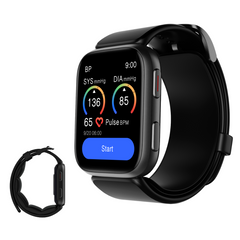
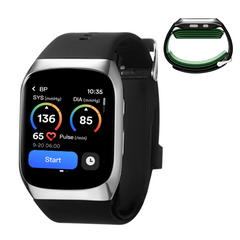
For someone who values measurements while traveling or away from home, a wearable or wrist-based device may serve a different need.
That is why these categories do not necessarily have to compete.
A household may use:
an upper-arm monitor for the regular home routine
and
a wearable solution for convenient checks away from the home setup.
Do You Need the Most Expensive Blood Pressure Monitor?
Not necessarily.
Current home blood pressure monitor reviews span a wide price range. NCOA's 2026 testing, for example, included home monitoring products priced from roughly $46 to $289.
Price often reflects:
- connectivity
- display quality
- memory
- brand
- cuff design
- ECG or other added functions
- construction
- ease-of-use features
But higher price alone does not prove better measurement performance.
Ask a better question:
What am I paying extra for?
If the answer is genuinely useful — easier cuff setup, verified regulatory status, appropriate cuff range, a simpler user interface, better household sharing, or functionality you will actually use — the premium may make sense.
If the only difference is marketing language, it may not.
A Simple Checklist Before You Buy
Before choosing an automatic upper-arm blood pressure monitor, ask:
Is it designed for upper-arm measurement?
Does the cuff fit my measured arm circumference?
Can I verify the exact model's regulatory or validation information?
Can I position myself and my arm correctly each time?
Is the display easy for me to read?
Will one or two people use it?
Do I want rechargeable power or replaceable batteries?
Am I comfortable wrapping a cuff, or would an integrated arm design make regular measurements easier?
If those questions are answered first, comparing the remaining features becomes much easier.
Frequently Asked Questions
Is an automatic upper arm blood pressure monitor better than a wrist monitor?
For routine home use, the American Heart Association recommends an automatic cuff-style upper-arm monitor. Wrist monitors can be useful in certain circumstances, but positioning is particularly important for wrist measurements.
How tight should an upper-arm blood pressure cuff be?
The cuff needs to fit according to the manufacturer's instructions and be suitable for your arm circumference. An incorrectly sized cuff can produce inaccurate readings. Always check the supported arm range before purchasing.
Can I measure blood pressure over clothing?
No. Both AHA and CDC guidance recommend placing the cuff against bare skin rather than measuring over clothing.
Should my arm be at heart level?
Yes. The measuring arm should be supported so the cuff area is around heart level. Incorrect positioning can influence the reading.
What does FDA Cleared mean for YHE BP Home?
Model CH-S693L is listed in FDA 510(k) K251102 as an Automatic Blood Pressure Monitor. The FDA determined the device to be substantially equivalent to its predicate device for its stated indications for use.
What arm sizes does YHE BP Home support?
The FDA 510(k) summary states that CH-S693L is intended for adults with an upper-arm circumference of 18–42 cm / 7.1–16.5 inches.
How many readings can YHE BP Home store?
The monitor supports two users with up to 99 stored readings per user, for up to 198 readings total, according to the product specifications.
Final Takeaway
Choosing an automatic blood pressure monitor is not mainly about finding the device with the longest feature list.
Start with the fundamentals:
upper-arm measurement
a cuff that fits
verifiable regulatory or validation information
correct measurement technique
and
a design you will actually use consistently.
For people who dislike wrapping and repositioning a traditional cuff, an integrated automatic upper-arm design offers another option.
YHE BP Home combines an integrated arm cuff with automatic oscillometric measurement, an 18–42 cm adult arm range, two-user memory, USB-C rechargeable power, and FDA 510(k) clearance under K251102.
The goal is not to make blood pressure monitoring more complicated.
It is to make a proper home measurement routine easier to keep.
Arm In. Press Start. Measure.
This article is for general educational purposes and is not a substitute for medical advice, diagnosis, or treatment. Talk with a healthcare professional about your blood pressure targets, measurement schedule, and interpretation of your readings.

Leave a comment
This site is protected by hCaptcha and the hCaptcha Privacy Policy and Terms of Service apply.