
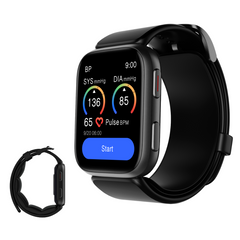
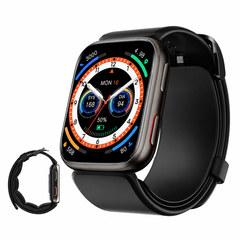
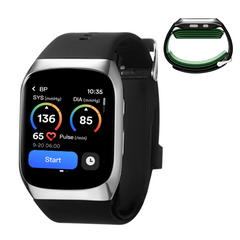
This is probably the most common question we receive about blood-pressure watches.
You measure:
128/78 on an upper-arm monitor.
Then:
136/82 on the watch.
The first reaction is often:
“Which one is wrong?”
That is not always the right question.
1. You Measured at Different Locations
An upper-arm monitor measures around the brachial artery.
A wrist monitor measures at the wrist.
Fit's manual explicitly states that measurements from the wrist and upper arm can differ because they are taken at different anatomical locations.
So perfect one-to-one agreement should not be assumed.
2. Your Wrist Was Not at Heart Level
This is the biggest controllable variable.
If the watch is resting:
- on your lap;
- beside your body;
- below the table;
it is probably below heart level.
Fit's manual warns that this can push the measured value higher.
Holding it too high can move the result in the other direction.
3. The Watch Was Too Loose
The inflatable cuff needs stable wrist contact.
A loose fit can produce unstable pressure signals.
4. You Took the Readings at Different Times
Blood pressure changes.
Five minutes can matter.
So can:
- coffee;
- exercise;
- stress;
- standing up;
- eating;
- talking;
- temperature.
Fit recommends comparing longer-term measurements under similar conditions rather than relying on random single checks.
5. You Measured Back-to-Back Too Quickly
Repeated inflation without enough recovery time can also change the conditions.
Fit recommends 2–3 minutes between repeated readings.
How to Compare More Fairly
If you want to understand how two devices behave:
- sit quietly;
- use the same general time window;
- keep correct position for each device;
- don't talk;
- wait the recommended interval;
- record several pairs over multiple days;
- look at patterns, not one pair.
If the difference is consistently large or you are using BP data for treatment decisions, talk to a healthcare professional.
AHA specifically recommends validated automatic upper-arm monitors for formal home BP monitoring.
Leave a comment
This site is protected by hCaptcha and the hCaptcha Privacy Policy and Terms of Service apply.