
A blood pressure watch advertised as “without calibration” may avoid reference-cuff setup, but that phrase does not establish accuracy, clinical validation or FDA clearance. It describes one task the owner may not have to perform. To choose well, separate that task from the evidence supporting the exact device.
This guide is published by YHE and was researched on October 22, 2026. It explains buying terminology rather than presenting a new accuracy study.
Four different ideas often get called calibration
| Term | What it means for the buyer | What it does not prove |
|---|---|---|
| User reference-cuff calibration | You supply cuff readings to personalize a wearable's estimate | That the wearable can replace the reference cuff |
| Factory calibration | The manufacturer adjusts or checks instrument components | That the finished product passed clinical validation |
| Clinical validation | The exact device is evaluated against a reference under a defined protocol | That every population and use condition is covered |
| A personal comparison with a home cuff | You investigate technique and whether results deserve further review | A clinical validation study or regulatory authorization |
Once these ideas are separated, “no calibration” becomes a useful convenience question instead of an all-purpose quality badge.
Why some optical wearables use a reference cuff
An optical sensor observes changes in light associated with blood flow. The device's software may use that information with other signals to estimate blood pressure. Some systems ask for upper-arm cuff readings to establish or refresh a personalized reference.
Samsung's U.S. BP workflow specifies recalibration every 28 days. Hilo Core's current U.S. guide specifies a four-day initial routine followed by a 30-day refresh. WHOOP's current explanation uses three initial cuff readings and recommends a new cuff reading every 30 days.
These examples show why a general statement such as “all cuffless watches calibrate once” is unreliable. They also show why the calibration schedule belongs in the ownership decision, alongside charging and membership. Follow the current instructions for the specific product.
Why an inflatable-cuff watch is different
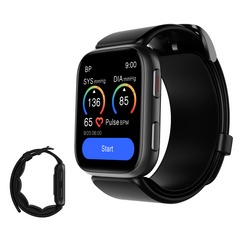
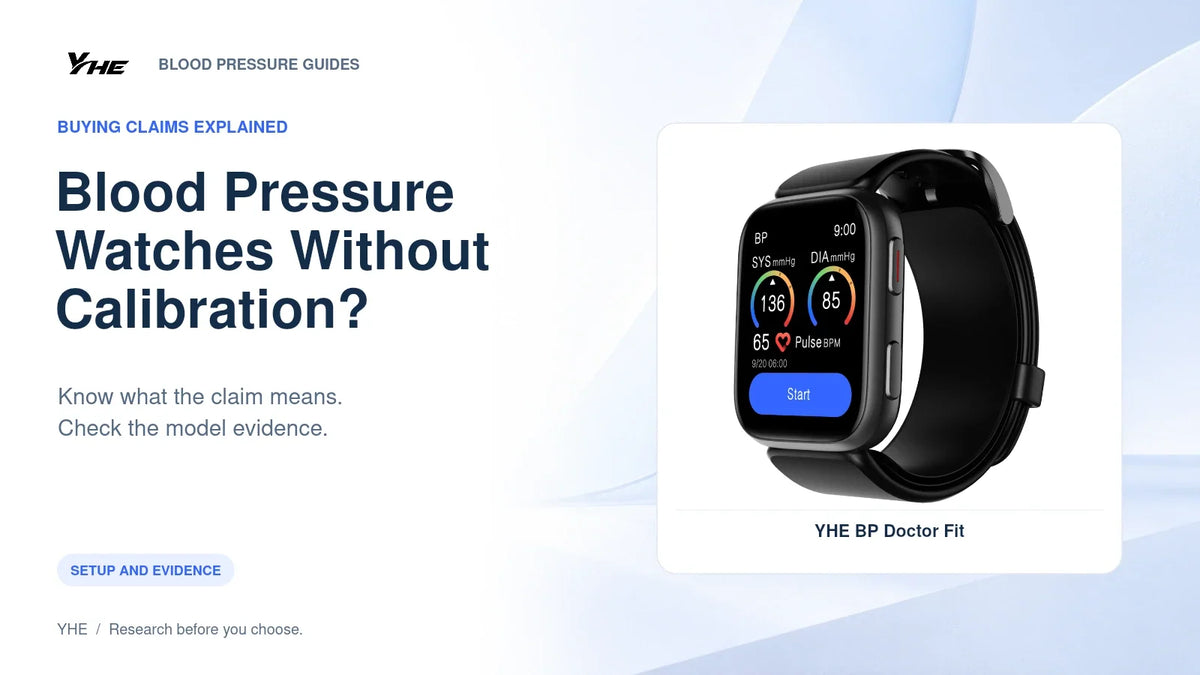
A cuff watch such as YHE BP Doctor Fit inflates a wrist cuff and uses an oscillometric measurement process. It does not advertise the same external reference-cuff setup step as the optical systems above.
That distinction may suit someone whose main objection is keeping another cuff available for repeated wearable calibration. However, the watch still needs correct cuff fit and measurement technique. Removing reference setup does not remove the need to stop, position the wrist and follow the instructions.
It also does not establish that all inflatable-cuff watches perform alike. The cuff, sensor, algorithm and evidence can differ. We did not verify a corresponding U.S. BP clearance for Fit in this research, and the measurement mechanism alone is not a substitute for one.
Use an evidence ladder before comparing convenience
- Name the exact model. Record the label identifier, not just the brand or marketplace title.
- Check the intended measurement. Does it provide a point-in-time pressure reading, an overnight estimate or a long-term signal?
- Review authorization for your market. For U.S. medical BP use, look for a matching device record and labeling.
- Read the validation evidence. Check the model, protocol, reference method and studied population.
- Check fit and instructions. Evidence from a device that does not fit you does not solve the practical problem.
- Then compare recurring tasks. Calibration, charging, subscriptions and record handling determine day-to-day effort.
The sequence matters. A convenient device that does not meet the required measurement or evidence standard should not win because it saves one setup step.
Be careful with three common “accuracy” shortcuts
“It matched my home cuff once”
One similar result does not show how the device performs across a range of pressures, people or conditions. A difference may also reflect timing, posture or fit. Use a concern as a reason to investigate, not as a reason to manually change the result until it matches.
“The specification says ±3 mmHg”
Determine what the number describes. A pressure-system tolerance is not automatically the same measure as clinical error across people. Two identical-looking figures can refer to different tests and cannot safely be used as a ranking table without context.
“It has FDA registration”
Establishment registration is different from marketing authorization for an exact BP device. A clearance number for another model, another component or another feature does not resolve the question.
What should you buy for your actual goal?
If the goal is a clinician-guided home record, start with the required device and measuring protocol. The American Heart Association recommends a validated upper-arm cuff monitor for home measurement. Choose convenience within that requirement rather than using convenience to replace it.
If the goal is researching a wearable for a particular nonclinical routine, compare the actual output, model evidence, wrist fit and recurring tasks. “Without calibration” can help distinguish workflows once the more consequential questions have been answered.
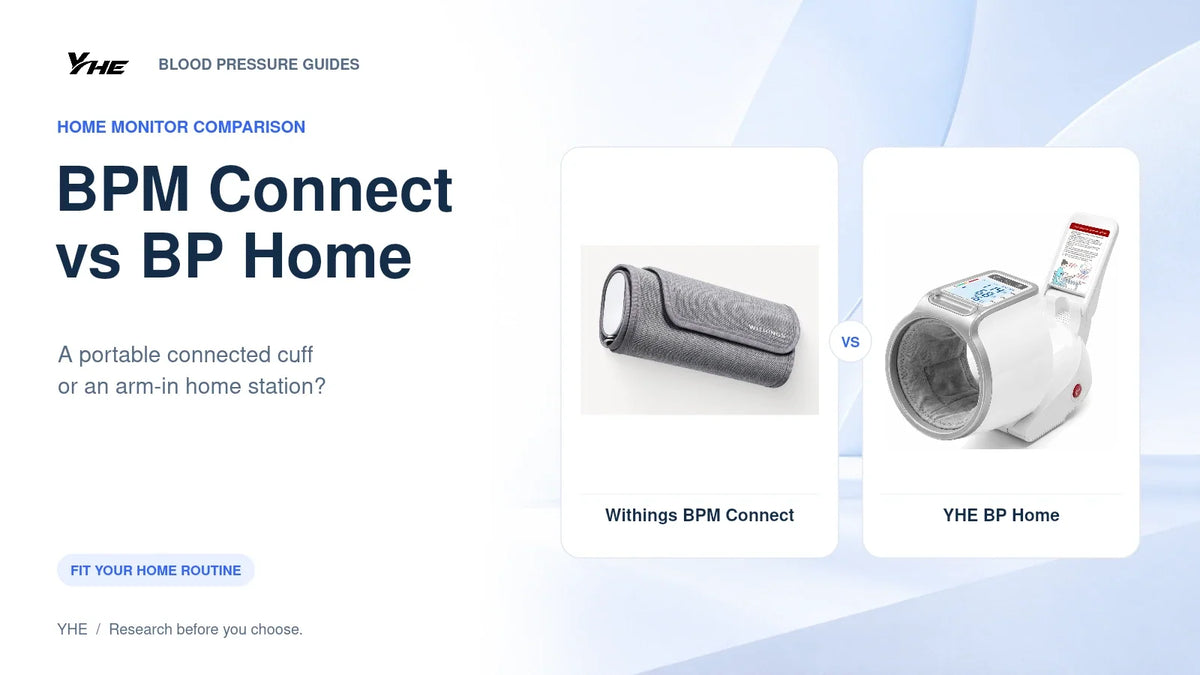
For YHE, compare Fit's cuff-watch workflow with the separate BP Home upper-arm model. BP Home's CH-S693L appears in K251102; that evidence belongs to the home monitor.
Frequently asked questions
Should I enter a different number to make a watch agree with my cuff?
Follow the manufacturer's calibration instructions exactly. Do not invent an offset or change a medical record to force agreement. Discuss unresolved discrepancies with the relevant support team and healthcare professional.
Does checking my device against a cuff mean calibrating it?
Only if the device's instructions define a calibration process that actually uses that input. Comparing two displayed results does not necessarily adjust either device.
Sources
Samsung calibration support; Hilo Core calibration; WHOOP current calibration explanation; AHA home-monitor selection; FDA BP-device safety communication; YHE links above.

Leave a comment
This site is protected by hCaptcha and the hCaptcha Privacy Policy and Terms of Service apply.