
The right Omron HeartGuide alternative depends on what you need to preserve: a wrist cuff, documented medical-device evidence, or a convenient home routine. Those requirements lead to different shortlists. Buying another watch because it resembles HeartGuide can miss the feature that mattered in the first place.
This guide is published by YHE using public documentation checked on October 22, 2026. It does not claim that HeartGuide has been discontinued, that any specific seller has stock, or that a YHE watch has equivalent clinical performance.
Start with the exact HeartGuide model
Omron's support material includes HeartGuide BP8000-M and BP8000-L. The medium BP8000-M manual specifies a 16–19 cm wrist circumference. Do not assume that a listing for “HeartGuide” includes the size you need, especially when buying old stock or a secondhand unit.
Check the model label, included cuff sleeve, charging equipment and current support path before comparing alternatives. A missing or worn measuring component can change the cost and usefulness of a purchase. An attractive resale price is not a complete working-system price.
For regulatory research, preserve the actual model identifiers. The FDA's K182481 record names HEM-6410T-ZM. Omron's clinical-validation resources provide additional model-level context. A marketplace title is not a substitute for matching the device and documentation.
There are three different meanings of “alternative”
| Your priority | Comparison to make | What to verify |
|---|---|---|
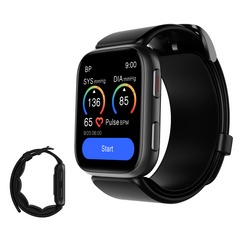
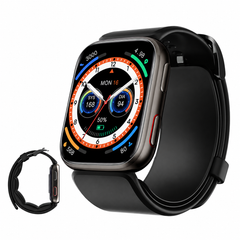
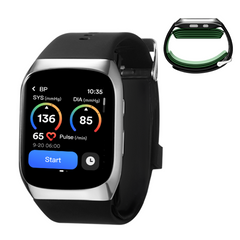
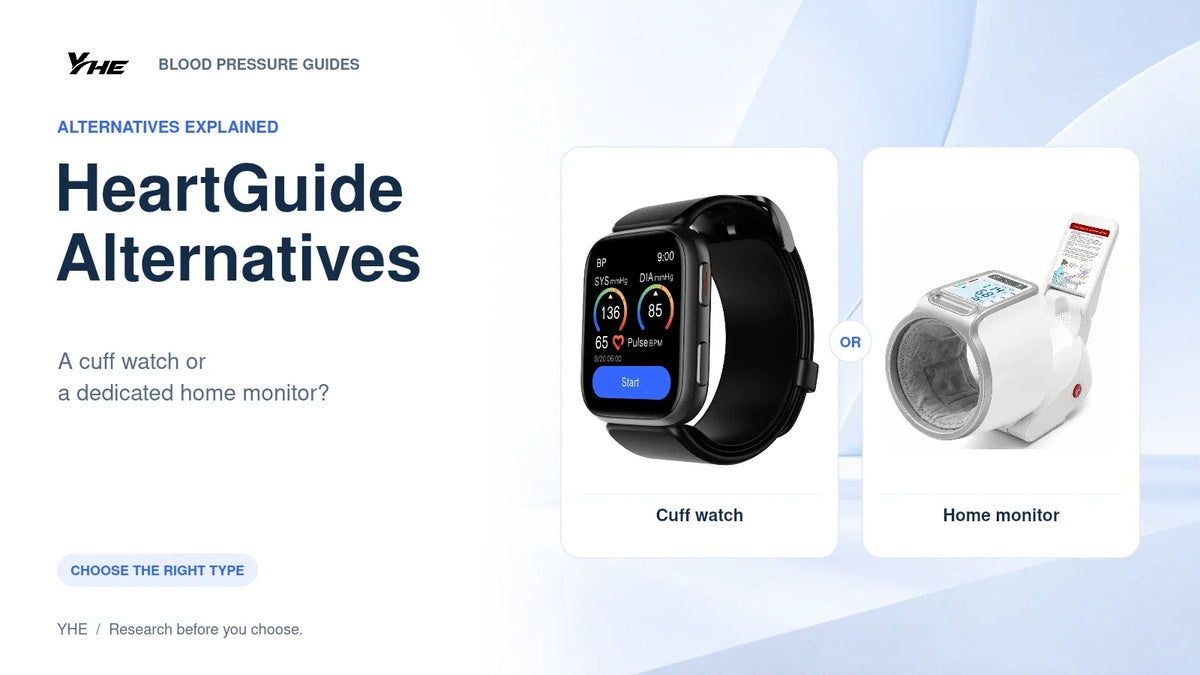
| A cuff built into a wearable | HeartGuide, Wellue BPW1, YHE cuff-watch options | Fit, operating instructions and exact evidence |
| A particular medical monitoring requirement | Devices appropriate to that requirement | Authorization, validation and clinician acceptance |
| An easier routine at home | Upper-arm monitors, including integrated arm-in designs | Arm fit, positioning, readability and record handling |
This framework avoids calling every BP-branded wearable a direct replacement. It also leaves room for the simplest answer: some shoppers searching for a watch would be better served by a home monitor.
If the wrist form is essential, compare the cuff first
The appeal of a wrist device is having it available when a quiet measurement opportunity arises. The measurement itself still requires the technique in its instructions. Wrist position is part of the task, not an optional detail that disappears because the device looks like a watch.
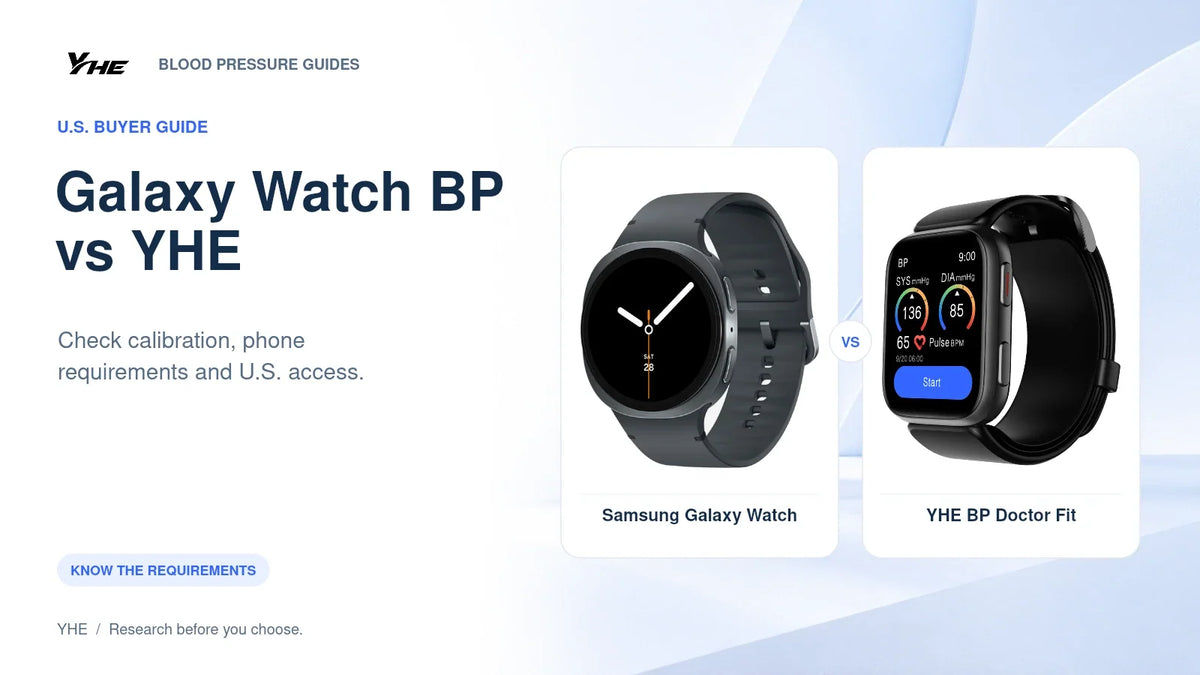
YHE's Fit has a published approximate 14–22 cm wrist range; Med has a different range and a dual-cuff design. A broader stated range is useful only if the cuff actually fits you. A second cuff is a hardware distinction, not sufficient evidence of superior accuracy.
If U.S. clearance is essential to your purchase, request a matching record for the exact watch. We did not verify one for Fit in this comparison. Wellue identifies BPW1 and K182018 in its retail documentation, which makes it another model to investigate rather than a reason to assume all cuff watches share that status.
If the original purchase was about home monitoring, reconsider the watch
Ask where most readings will happen. If the answer is a chair beside the same table every morning, a stationary upper-arm system may remove more friction than a wrist device. You can leave it ready, keep a consistent position and make the display easy to see.
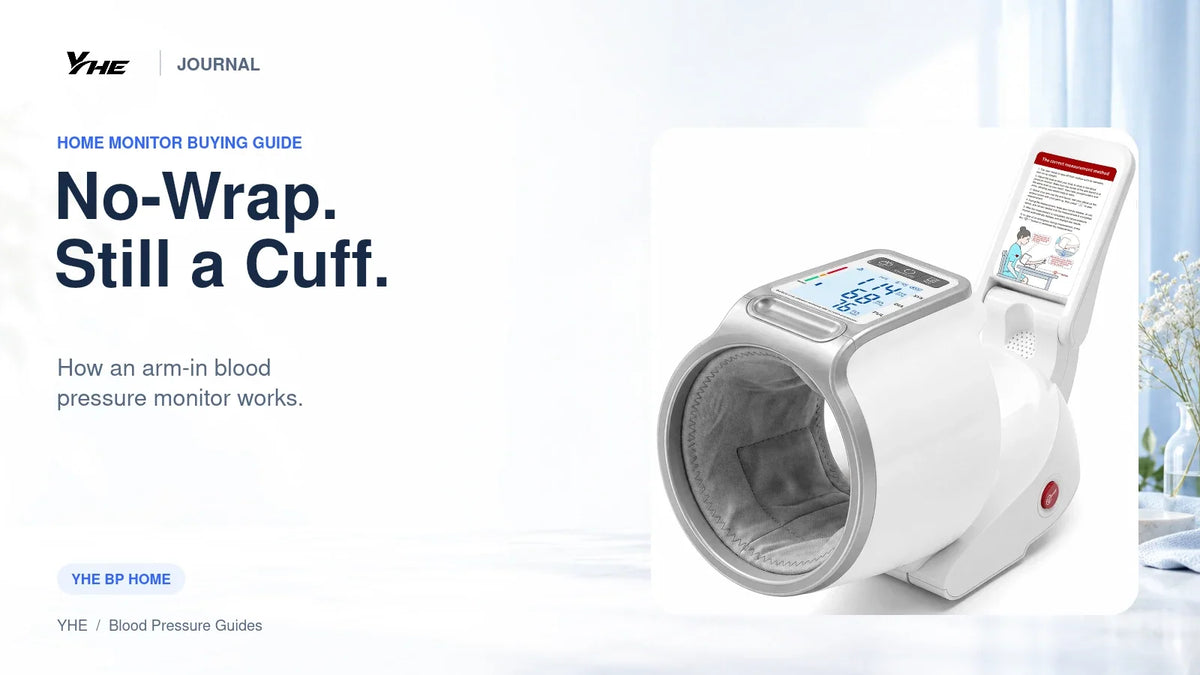
YHE BP Home uses an integrated arm-in cuff rather than a loose cuff that must be manually wrapped for each reading. Its listed adult arm range is 18–42 cm. The CH-S693L model appears in FDA clearance K251102. This is separate evidence for the home monitor, not for YHE's watches.
The design may be attractive if wrapping is the specific obstacle. It does not remove the need for correct arm placement, suitable furniture and a proper fit. If movement or disability makes setup difficult, assess the complete routine with the intended user rather than assuming an arm-in design solves every accessibility problem.
Support can outweigh a small price difference
Before replacing an existing HeartGuide, identify why it no longer meets your needs. Is the issue the battery, cuff wear, fit, app access or the desire for a different measurement process? A replacement accessory may solve a different problem from a new device.
For any alternative, ask how to obtain replacement measuring parts, which records can be retained and who handles a failure. For a product bought outside its intended market, confirm whether local service is available. These questions are especially valuable when the purchase is for a family member who will not troubleshoot an app alone.
Compare current seller terms instead of repeating an old HeartGuide launch price. We have not established a current official purchase price or stock position here, so a numerical “savings versus HeartGuide” claim would be misleading.
Choose by the routine you will keep
Make a short list of essential tasks before shopping: put it on correctly, start a reading, see the result, retain the record and repeat the process. Then test the proposed workflow on paper. If a watch requires a wrist posture you find uncomfortable, portability may not help. If a home monitor requires storage and repeated setup, an accessible permanent location may matter more than an extra app feature.
For YHE options, use the watch comparison for form and fit, and examine BP Home for the home routine. Discuss a device intended for medical care with your healthcare professional.
Common questions
Is another inflatable-cuff watch automatically a HeartGuide replacement?
No. A similar mechanism does not establish the same validation, intended use, available sizes or support. Match the requirement that caused you to consider HeartGuide.
Can HeartGuide be used as a 24-hour ambulatory monitor?
Do not infer that from its wearable form. Follow the exact model's manual; the BP8000-M instructions specifically distinguish its use from ambulatory use. A clinician-requested assessment needs an appropriate protocol and device.
Sources
Omron model support; BP8000-M manual; Omron clinical-validation resources; FDA K182481; FDA K251102. No hands-on testing or accuracy ranking is claimed.

Leave a comment
This site is protected by hCaptcha and the hCaptcha Privacy Policy and Terms of Service apply.