

“Most accurate.”
“Clinical grade.”
“Medical accuracy.”
“Doctor-level.”
These phrases sound reassuring.
They are also exactly the kind of phrases consumers should examine carefully.
If you are looking for the most accurate blood pressure watch, a better strategy is not to search for the boldest claim.
It is to ask:
What evidence supports the claim?
Accuracy Is Not One Number
A device's performance depends on more than a specification printed on a product page.
You need to consider:
- measurement method;
- test protocol;
- measurement site;
- cuff fit;
- population tested;
- regulatory status;
- user technique;
- comparison device.
That is why a single phrase such as:
“±3 mmHg”
should not automatically be interpreted as:
“This is the most accurate watch in the market.”
Those are completely different claims.
Step 1 — Understand the Measurement Method
A watch with a physical inflatable cuff works differently from a sensor-based BP estimate.
Fit and Med documentation describes oscillometric wrist measurement using inflatable cuffs.
That tells you what type of signal is being measured.
It does not, by itself, prove that one commercial product is more accurate than every competitor.
Step 2 — Check Whether the Device Is Authorized Where It Is Sold
This is especially important in the United States.
In September 2025, the FDA warned consumers against unauthorized devices—including wearable software features—that claim to measure or estimate blood pressure. The FDA recommends checking whether the specific product has appropriate authorization.
That means:
“FDA registered company”
is not the same question as:
“Is this exact BP-measuring device authorized?”
Step 3 — Look for Validation, Not Just Marketing
For home blood pressure monitoring, the AHA recommends choosing a validated automatic upper-arm cuff monitor.
For wearable products, the regulatory and validation landscape is different and is changing quickly.
So when a brand uses phrases like:
clinically validated
or
medical accuracy
look for:
- exact model;
- test standard;
- actual study;
- regulatory record;
- population;
- comparison protocol.
Step 4 — Separate Measurement Tolerance From Market Superiority
This is where ecommerce copy often goes wrong.
A technical specification may state an allowable pressure error or test tolerance.
That supports:
“Specified pressure tolerance: X.”
It does not automatically support:
“More accurate than Apple, Samsung, Omron and every other product.”
Comparative superiority requires comparative evidence.
Step 5 — Technique Can Overwhelm Small Hardware Differences
For wrist measurement, incorrect position matters enormously.
Fit's instructions say:
- wrist too low may produce higher readings;
- wrist too high may produce lower readings;
- loose/tight wearing affects measurement;
- movement and talking can interfere.
This means a theoretically good device used badly can give poor real-world results.
Step 6 — Don't Expect Wrist and Upper Arm to Match Perfectly
The Fit manual explicitly notes that wrist and upper-arm measurements may differ because they are taken at different locations.
So this is a weak accuracy test:
“My arm cuff said 127. My watch said 132. Therefore the watch is wrong.”
A better evaluation looks at:
- proper use;
- repeated measurements;
- consistent conditions;
- trend;
- appropriate reference method.
Step 7 — Be Suspicious of Impossible Claims
Red flags include:
“100% accurate”
No measurement device works that way.
“Never needs correct positioning”
Wrist position matters.
“Replaces your doctor”
It doesn't.
“Continuous blood pressure” when BP is actually on demand
Fit's cuff measurements are started on demand; reminders do not turn them into continuous monitoring.
“FDA approved” without an exact record
Check the terminology and the exact model.
So Which YHE Model Is the Most Accurate?
I would not publish a statement saying:
“Fit is the most accurate.”
or
“Med is the most accurate blood-pressure watch.”
unless YHE has a controlled head-to-head validation study that supports that exact comparison.
That is the correct answer from both an SEO-quality and compliance standpoint.
What we can say is:
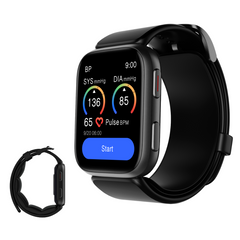
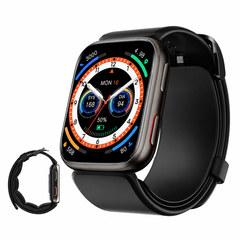
- Fit and Ultra use a single inflatable wrist cuff;
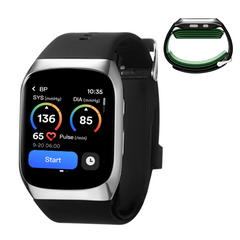
- Med uses dual inflatable cuffs;
- all require correct wrist fit and heart-level positioning;
- the buying decision should consider measurement design, fit, usability and supporting evidence.
What a Good Product Page Should Show
Instead of saying “most accurate,” show:
- measurement principle;
- cuff design;
- exact fit range;
- test methodology;
- regulatory evidence where applicable;
- user instructions;
- real-world comparison methodology;
- limitations.
Transparency is more convincing than a superlative.
FAQ
What is the most accurate blood pressure watch?
There is no responsible universal answer without defining the devices, validation method, population and test conditions being compared.
Does a cuff automatically make a watch accurate?
No. Cuff design is only one part of the system.
Does position affect a cuff-based wrist watch?
Yes. Heart-level positioning and fit are important.
Should a BP watch replace an upper-arm monitor?
For formal home monitoring and treatment decisions, AHA recommends validated upper-arm monitors and advises users to work with healthcare professionals.
Final Takeaway
If a brand can only prove:
“We are the most accurate.”
with a large font,
it has not proved very much.
Look instead for:
measurement method
fit
validation
regulatory evidence
correct technique
transparent limitations
That is how you evaluate a serious blood-pressure product.
Compare YHE models
Fit · Ultra · Med · Compare Models
Leave a comment
This site is protected by hCaptcha and the hCaptcha Privacy Policy and Terms of Service apply.