

Search for a blood pressure watch and you will quickly run into another phrase:
blood pressure smartwatch.
They sound interchangeable.
In product listings, they often are.
But two watches carrying the same “blood pressure” label can work in completely different ways.
One may physically inflate a cuff around the wrist.
Another may use optical sensors and estimate blood pressure after calibration.
A third may not provide systolic and diastolic readings at all, but instead look for patterns associated with possible hypertension.
For buyers, that difference matters far more than whether a product calls itself a “watch” or a “smartwatch.”
The Most Important Question Is Not the Name
Before comparing screens, apps or battery life, ask:
What actually happens when I take a blood pressure reading?
There are currently three broad approaches.
1. A physical inflatable cuff
The watch contains a small inflatable air cuff in the wristband.
When the measurement starts, the cuff applies pressure around the wrist. The device analyzes the pressure signals and displays a systolic and diastolic result.
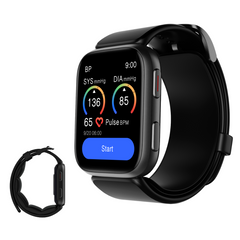
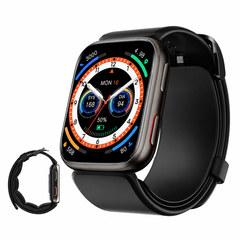
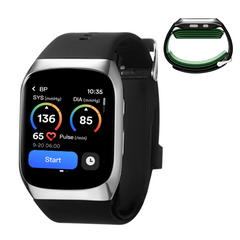
YHE BP Doctor Fit and Ultra use a single inflatable wrist cuff; Med uses a dual inflatable cuff design. Fit's manual describes pressure-based wrist measurement using an air cuff and an oscillometric method.
2. A sensor-based estimate after calibration
Some smartwatches use optical sensor information instead of physically inflating a cuff.
Samsung's U.S. blood-pressure feature is a good current example. Compatible Galaxy Watches require calibration with a separate upper-arm blood pressure cuff, followed by recalibration every 28 days.
3. Hypertension-pattern detection
This is different again.
Apple Watch hypertension notifications analyze optical heart-sensor data over time for patterns associated with possible chronic high blood pressure. Apple does not present this feature as a traditional on-demand systolic/diastolic blood-pressure reading; users receiving a notification are advised to log blood pressure with a separate cuff.
So What Should “Blood Pressure Watch” Mean to a Buyer?
Do not rely on the category name alone.
Instead, look for answers to five questions:
| Question | Why It Matters |
|---|---|
| Does anything physically inflate? | Tells you whether the watch uses a cuff |
| Does it show SYS/DIA readings? | Distinguishes measurement from notification |
| Is external cuff calibration required? | Changes the everyday workflow |
| Is BP on-demand or continuous? | Prevents misunderstanding |
| How sensitive is it to wrist position? | Important for repeatability |
This is particularly important because the FDA has warned consumers about unauthorized wearable devices that claim to measure or estimate blood pressure. The FDA recommends checking whether the exact blood-pressure device has appropriate U.S. marketing authorization rather than trusting a generic claim.
Where BP Doctor Fits
The current BP Doctor lineup is centered on inflatable wrist-cuff measurement.
BP Doctor Fit uses an integrated inflatable cuff and oscillometric wrist measurement. Its recommended BP wrist range is approximately 14–22 cm, and the watch can store the latest 10 readings locally while additional history can be viewed in the app.
Ultra uses the same general single-cuff BP approach but adds the premium exterior/UI package and one year of Premium App access.
Med uses a different dual inflatable cuff structure and is designed around approximately 14–20 cm wrists.
Which Approach Is Better?
There is no single answer.
An inflatable-cuff watch may appeal to someone who specifically wants a physical cuff built into the wearable.
A calibrated sensor-based system may make more sense for someone already committed to a compatible smartwatch ecosystem.
A hypertension-notification feature serves a different goal: awareness rather than taking an on-demand traditional BP reading.
The mistake is comparing them as though all three do the same thing.
What About an Upper-Arm Monitor?
This is where wearable convenience and home BP monitoring need to be separated.
The American Heart Association currently recommends an automatic, validated upper-arm cuff-style monitor for home blood pressure monitoring. Wrist measurements are more sensitive to position.
That does not make a wrist BP watch pointless.
It gives it a different value proposition:
A wrist-based measurement option that is easier to keep with you.
A buyer concerned about medical treatment decisions should talk with a healthcare professional about the type of device appropriate for those decisions.
Quick Buying Checklist
Before buying any blood pressure smartwatch, check:
- how the blood-pressure feature actually works;
- whether it physically inflates;
- whether an external cuff is required;
- the supported wrist size;
- whether readings are on demand;
- instructions for correct wrist position;
- regulatory status where relevant;
- how historical readings are stored;
- whether the device's intended use matches what you expect it to do.
FAQ
Is every blood pressure smartwatch a blood pressure monitor?
No. Some provide on-demand readings, some estimate readings after calibration, and some only provide hypertension-related notifications.
Do BP Doctor watches have inflatable cuffs?
Fit and Ultra use integrated single inflatable wrist cuffs. Med uses a dual inflatable cuff structure.
Does a blood pressure watch measure continuously?
Not necessarily. BP Doctor Fit's blood-pressure readings are started on demand; reminders can be scheduled, but that is different from continuous BP measurement.
Is a blood pressure smartwatch a replacement for medical care?
No. Wearable health information should not be used independently to diagnose a condition or change treatment.
Final Takeaway
“Blood pressure watch” is a category label.
The measurement method is what actually tells you what you are buying.
Before comparing smart features, start with the cuff, sensors and measurement workflow.
Explore the YHE lineup
BP Doctor Fit · BP Doctor Ultra · BP Doctor Med · Compare BP Doctor Models
Leave a comment
This site is protected by hCaptcha and the hCaptcha Privacy Policy and Terms of Service apply.