
Two adults can share a blood pressure monitor when the device is suitable for both, the cuff fits each person, and their records stay separate. A two-user memory feature helps with the last part; it does not guarantee the first two.
If you are buying one monitor for a couple this Christmas, check how it will be used in the household. Sharing can be convenient, but only if both people can operate the device and identify their own results without confusion.
In this guide
What does “two-user memory” mean?
A monitor with two-user memory provides separate storage for two user profiles. It is designed to help prevent one person's measurements from being mixed into the other's history.
Read the capacity carefully. “2 × 99” means space for 99 readings per user, rather than 198 readings allocated freely to either person. A reading is not necessarily a full morning-and-evening day of monitoring.
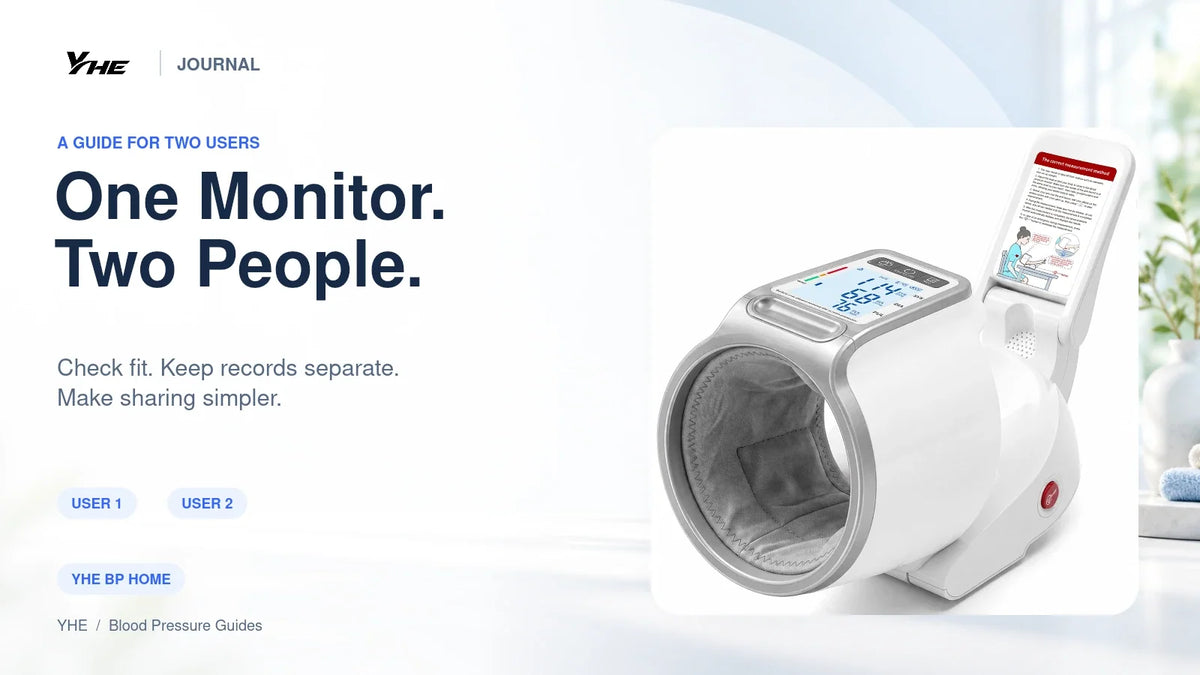
The YHE BP Home specifications list two users with 99 readings each. Check its instructions for profile selection and memory operation before the first session.
Measure both users before ordering
Use an actual circumference measurement for each person's upper arm and compare both with the product's stated range. Do not use clothing size, height or body weight as a shortcut.
The FDA documentation for CH-S693L under K251102 specifies an adult arm circumference range of 18–42 cm. If either person's arm falls outside that range, the household needs a different cuff or device arrangement.
Even if both measurements fit the range, confirm that each person can comfortably use the monitor in the planned location. The chair height and arm access that suit one person may be awkward for the other.
Agree on a simple profile routine
Choose an unambiguous assignment: for example, Alex uses User 1 and Sam uses User 2. Keep a short reminder near the device if that helps, without covering the display or controls.
Before each measurement, check the selected profile. Afterwards, confirm that the result has been associated with the correct person. A habit of checking twice is easier than trying to reconstruct a mixed record a week later.
If a reading is saved under the wrong profile, make a note explaining the error and consult the instructions about correcting or managing records. Do not silently present that history as a clean personal log.
How long does 99-reading memory last?
Capacity is easier to understand when you convert it into your actual schedule. Suppose a clinician has asked one person to take two readings in the morning and two in the evening. That is four readings per day.
99 ÷ 4 = 24 complete days, with room for three additional readings. This is a storage example, not a recommended schedule for everyone. Additional measurements would use the available capacity sooner.
For that reason, do not treat device memory as a permanent medical archive. Keep or transfer a separate record in a format your healthcare professional can review. Confirm how the device handles a full memory rather than guessing whether old results remain available.
One shared monitor or two separate devices?
| Household situation | What to consider |
|---|---|
| Both users live together and fit the cuff | A shared device with clearly separated records may be practical |
| One user travels frequently | Taking the only monitor away may interrupt the other's routine |
| Different cuff sizes are required | Check compatible cuff options or separate devices |
| Profiles are often confused | A simpler labeling routine or separate monitors may help |
| One person needs a specialized monitoring plan | Let their healthcare professional guide the device choice |
There is no saving in sharing a monitor if one person cannot use it when needed. Compare convenience and access, not just the cost of buying one unit instead of two.
Keep cleaning and privacy part of the plan
Follow the manufacturer's cleaning instructions for a shared device. Do not apply liquids, cleaners or disinfectants that the instructions do not permit.
Also agree on privacy. Sharing hardware does not automatically mean sharing every result with each other or with other family members. Each person should decide who may see their readings and who will help with appointments.
If one person manages the paperwork, label each log clearly and check the names before sending or printing it. A convenient household system still needs individual records.
What about sharing a blood pressure watch?
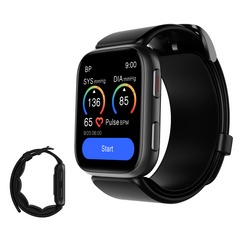
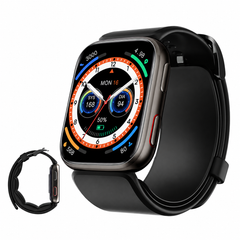
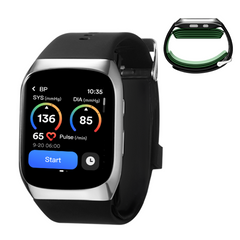
A personal wearable and a two-user home monitor solve different household needs. Passing one watch between two people involves repeated sizing, wearing and recordkeeping decisions.
A Guest Mode, where supported, is not necessarily the same as two independently maintained user histories. Ask about the exact behavior if shared use is important to you.
For a couple who each want a wearable, compare personal devices individually. For a couple who mainly want a dedicated place to take home readings, examine a shared upper-arm monitor first.
Frequently asked questions
Can my spouse and I use the same monitor?
Potentially, if it is suitable for each person, fits both correctly and allows you to keep records separate. Follow the device instructions and any individual clinical advice.
Does 2 × 99 mean 198 readings per person?
No. It means 99 readings for each of two users.
Does one person's result change what is normal for the other?
No. Each person needs their own monitoring plan and interpretation from their healthcare professional. Do not compare spouses as if one sets the other's target.
Is a shared monitor a useful Christmas gift for parents?
It can be if both want it, both fit and both can use it. Confirm these points before choosing a household gift.
See BP Home's two-user specifications and check the fit for both people before ordering.
Sources and further reading
- FDA CH-S693L intended-user and arm-range information
- NHLBI self-measured blood pressure information
- BP Home memory specifications
Product information checked October 22, 2026. The capacity calculation illustrates storage use, not a personalized measurement schedule.

Leave a comment
This site is protected by hCaptcha and the hCaptcha Privacy Policy and Terms of Service apply.