

Why Blood Pressure Watch Readings Change
You take one reading.
Then another.
They are different.
Is the watch inaccurate?
Sometimes the better question is:
What changed between the two measurements?
Blood pressure itself changes throughout the day, and wrist measurement adds several technique-sensitive variables.
Here are eight common reasons.
1. Your Wrist Was Not at Heart Level
This is one of the biggest mistakes.
Fit's manual specifically states:
- below heart level can push the reading higher;
- above heart level can push it lower.
A better routine is:
sit → support elbow → bring wrist to heart level → relax.
2. The Watch Was Too Loose
A loose cuff may not have stable contact with the wrist.
Fit's documentation tells users to ensure the air cuff sits flat and correctly against the wrist and suggests tightening the strap if readings show large deviation or unstable signals.
3. The Watch Was Too Tight
“Tighter is always better” is also wrong.
The manual notes that excessive tightness can affect measurements.
You want:
secure
not
painfully compressed.
4. You Moved
The watch is trying to detect pressure oscillations generated by the pulse.
Moving your hand, tensing the forearm, clenching the fist or shaking the table adds noise.
Fit explicitly instructs users not to bend the wrist, clench the fist, shake or talk during the reading.
5. You Talked
Even a casual conversation changes the measurement environment.
Both YHE documentation and standard home BP guidance emphasize remaining quiet during measurement.
6. You Measured at a Different Time
Blood pressure is not a constant number.
It responds to:
- activity;
- stress;
- meals;
- alcohol;
- smoking;
- temperature;
- sleep;
- time of day.
Fit's manual recommends measuring at a similar time each day when the goal is to understand longer-term trends.
7. You Measured Too Soon After Exercise, Smoking or Drinking
Fit's instructions tell users to avoid vigorous exercise, smoking, drinking and strong emotional changes for 30 minutes before measurement.
That is why:
checking immediately after walking quickly up the stairs
and:
checking after sitting quietly
are not equivalent tests.
8. You Repeated the Measurement Too Quickly
Repeated cuff inflation changes the local measurement conditions.
Fit's manual recommends at least a 2–3 minute interval between repeated measurements.
Follow the instructions for your specific device.
A Better Consistency Checklist
Before every wrist BP measurement:
| Check | Goal |
|---|---|
| Watch location | Correct spot on bare wrist |
| Strap | Secure, air cuff flat |
| Body | Seated and relaxed |
| Wrist | Around heart level |
| Hand | Relaxed |
| Voice | No talking |
| Movement | Stay still |
| Timing | Similar conditions |
| Repeat reading | Allow recommended interval |
What “Consistent” Really Means
It does not mean:
every reading must be exactly the same.
Human blood pressure changes.
The goal is to reduce avoidable measurement noise so the trend becomes more useful.
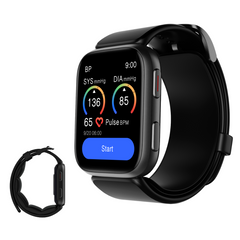
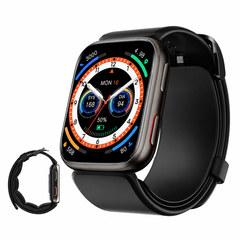
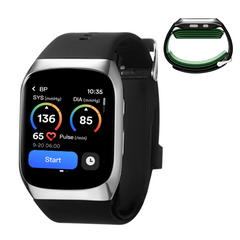
Fit, Ultra and Med Still Require Technique
A more expensive watch cannot cancel poor posture.
Fit and Ultra use single-cuff measurement; Med uses dual cuffs. All still require proper wrist position.
That is why YHE's product education should consistently teach:
fit
heart level
stillness
repeatable routine
instead of only promoting hardware specifications.
FAQ
Why does my blood pressure watch give different numbers?
Blood pressure naturally changes, and wrist height, cuff fit, movement and timing can also affect readings.
Should I take many measurements until I get a number I like?
No. Follow the manufacturer's measurement and interval instructions rather than repeatedly testing.
Should the watch be very tight?
It should be secure enough for correct cuff contact but not excessively tight.
How long should I wait between Fit readings?
Fit's instructions recommend at least 2–3 minutes between repeated measurements.
Final Takeaway
When readings vary, don't immediately blame the sensor.
First control what you can control:
same position
same fit
same conditions
same routine
That turns isolated numbers into a more useful pattern.
Product links
Fit · Ultra · Med · Compare Models
Leave a comment
This site is protected by hCaptcha and the hCaptcha Privacy Policy and Terms of Service apply.